

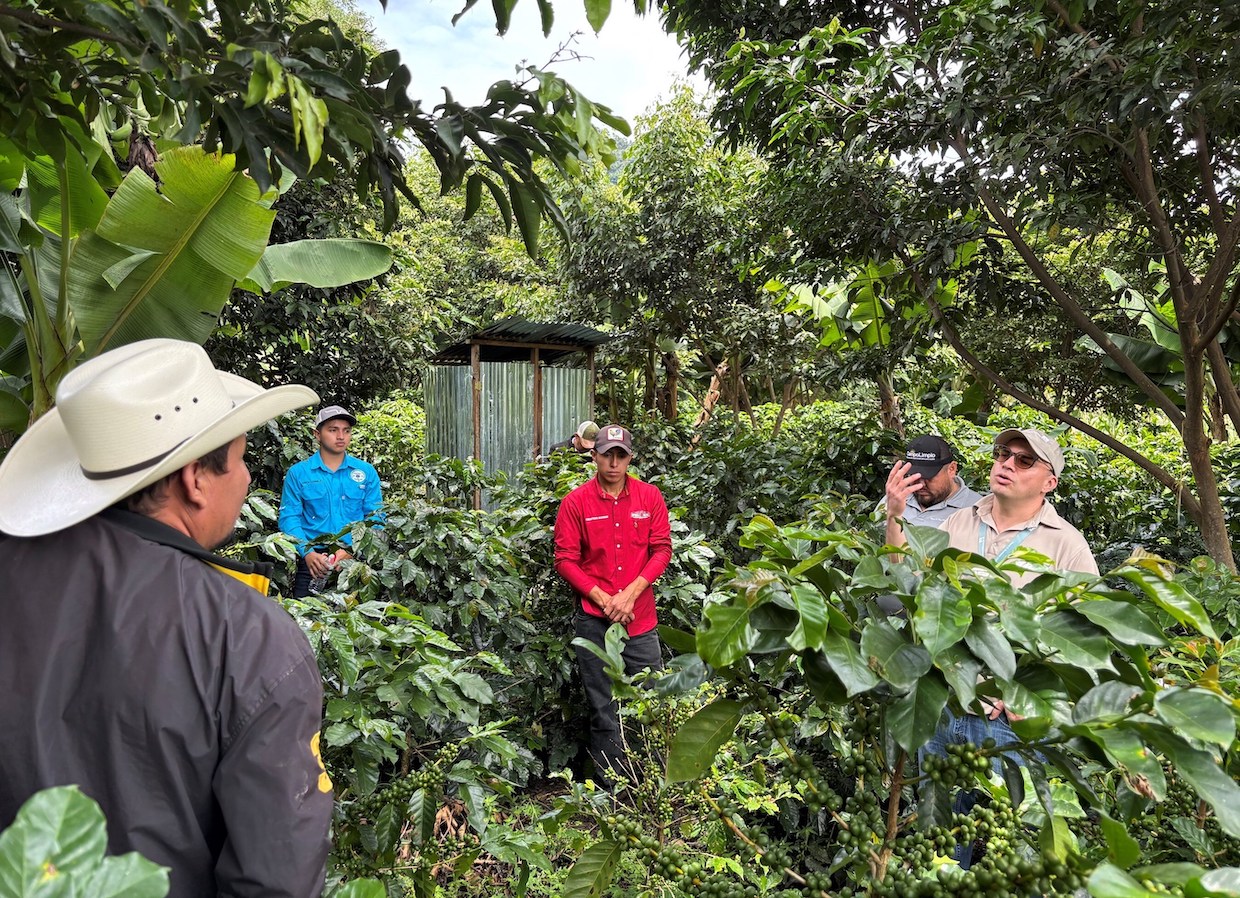
Smallholder farmers from the Lempira region participating in the CSCR Honduras project inspect a field. Press photo.
Numerous global coffee roasting companies are banding together for a four-year project designed to help smallholder coffee families in western Honduras cope with climate change, protect forests and maintain quality coffee production.
U.S.-based J.M. Smucker Co., Austria-based Julius Meinl and Germany-based Tchibo announced the project, called Climate-Smart Coffee Region (CSCR Honduras), in collaboration with the nonprofit Hanns R. Neumann Stiftung (HRNS)
The project is designed to benefit about 4,000 smallholder coffee farmers and roughly 20 producer organizations that together account for approximately 6,000 hectares of coffee land in the western Honduras regions of Ocotepeque, Copán and Lempira.
In an announcement this week, Julius Meinl said the four-year initiative (2025-2029) is “open for additional partners interested in contributing to this collaborative effort.”
HRNS Honduras will implement the program on the ground.
While there is no universal definition of “climate-smart” coffee, the companies said the initiative will employ proven climate adaptation tools, including soil and water conservation, agroforestry practices, erosion control, microclimate monitoring and household innovations such as fuel-efficient stoves and water-saving devices.
“Western Honduras is ecologically rich but also increasingly vulnerable to climate change,” said HRNS Program Manager Theresa Ruperti, noting recent prolonged droughts, rising temperatures and reduced yields. “By linking coffee productivity, community resilience and ecosystem conservation, the CSCR Honduras project supports farmers’ livelihoods and positions Western Honduras as a model for climate-smart and biodiversity-positive coffee farming in Central America.”
The work will focus on communities in and around protected areas such as Celaque, Erapuca, Las Minas and Volcán Pacayita. The aim is to turn vulnerable coffee landscapes in these buffer zones into “biodiversity-friendly” systems that protect local ecosystems while keeping coffee as a viable livelihood. Financial literacy training, women’s leadership programs and youth entrepreneurship are among the additional project strategies.
The project’s backers say they hope to position western Honduras as a model for “biodiversity-positive” coffee farming in Central America — meaning farms that not only avoid harming forests and wildlife but also help restore them.
The governance model is built around inter-municipal platforms known as Higuito and MAPANCE, which are meant to bring together local governments, civil society groups and other actors around joint climate goals. Honduras’ national coffee institute, IHCAFE, will take the technical lead on farmer training, research and monitoring, while a regional “community of practice” will connect 25 local organizations to share lessons and coordinate work.
Comments? Questions? News to share? Contact DCN’s editors here. For all the latest coffee industry news, subscribe to the DCN newsletter.
Related Posts



Comment