


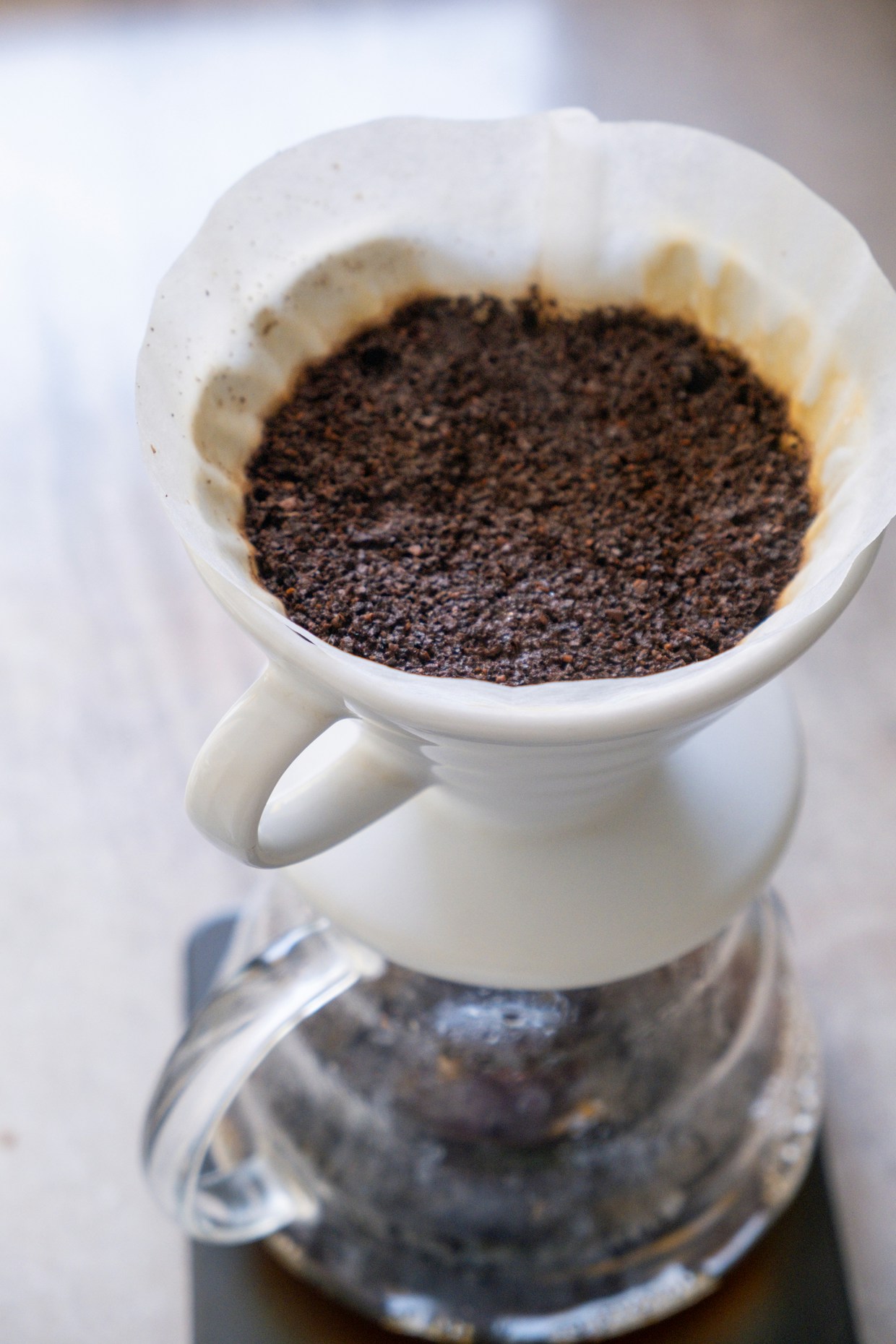
Multiple new studies propose pathways for spent coffee grounds to find a second life as a filter for contaminated water.
Looking beyond compost bins and landfills, researchers at the UK’s Loughborough University tested ways to turn coffee waste into low-cost “adsorbents” — materials that can bind and capture dissolved contaminants — targeting heavy metals such as lead, copper and zinc.
Building on previous studies that highlight spent coffee’s potential as adsorptive stuff, the new works move toward tested, real-world applications while offering another option for circularity in coffee.
One study — published in the Elsevier title Biomass and Bioenergy — focuses on converting spent grounds into a porous biochar and optimizing the process for lead removal. The second — published in MDPI’s Clean Technologies — tests treated coffee waste, alone and blended with rice husk biochar, in a fixed-bed column designed to remove copper and zinc at low concentrations.
Lead Removal From Biochar
In the Biomass and Bioenergy paper, conducted in collaboration with India’s Banaras Hindu University, the researchers heated used coffee grounds taken from a Loughborough University cafeteria to produce highly porous biochar, a material also known to improve soil quality.
After testing multiple biochar formulations based on temperature, heating rate and heating time, the researchers found that the optimal formulation was able to remove nearly 98% of lead from water, with the biochar holding 4.9 milligrams of lead per gram.
“By optimising the decomposition conditions, we were able to significantly enhance the material’s performance while keeping the process low-cost and environmentally friendly,” Monika Mahajan, lead author of the study, said in an announcement of the publication. “It is exciting to see a circular-economy approach translate into a practical solution for real-world water treatment challenges.”
Adsorbing Copper and Zinc
The second study used “barista coffee waste” from a commercial espresso machine on campus, then washed, dried and sieved it into a defined particle size range.
The researchers studied two formulations for the removal of copper and zinc — one with the coffee residues alone and one with a 50/50 mix of coffee residues and rice husk biochar.
After testing contact time, adsorbent type and metal concentration, the researchers found that both formulations proved highly effective at adsorbing copper and zinc, with one test removing 96% of the metals.
“Our studies show that what we often dismiss as waste, like spent coffee grounds, can actually become powerful materials in tackling environmental pollution,” lead author Basmah Bushra said. “By turning waste into adsorption material, we can not only reduce landfill burdens but also create affordable materials for cleaning up contaminants.”
Comments? Questions? News to share? Contact DCN’s editors here. For all the latest coffee industry news, subscribe to the DCN newsletter.
Related Posts


Comment