


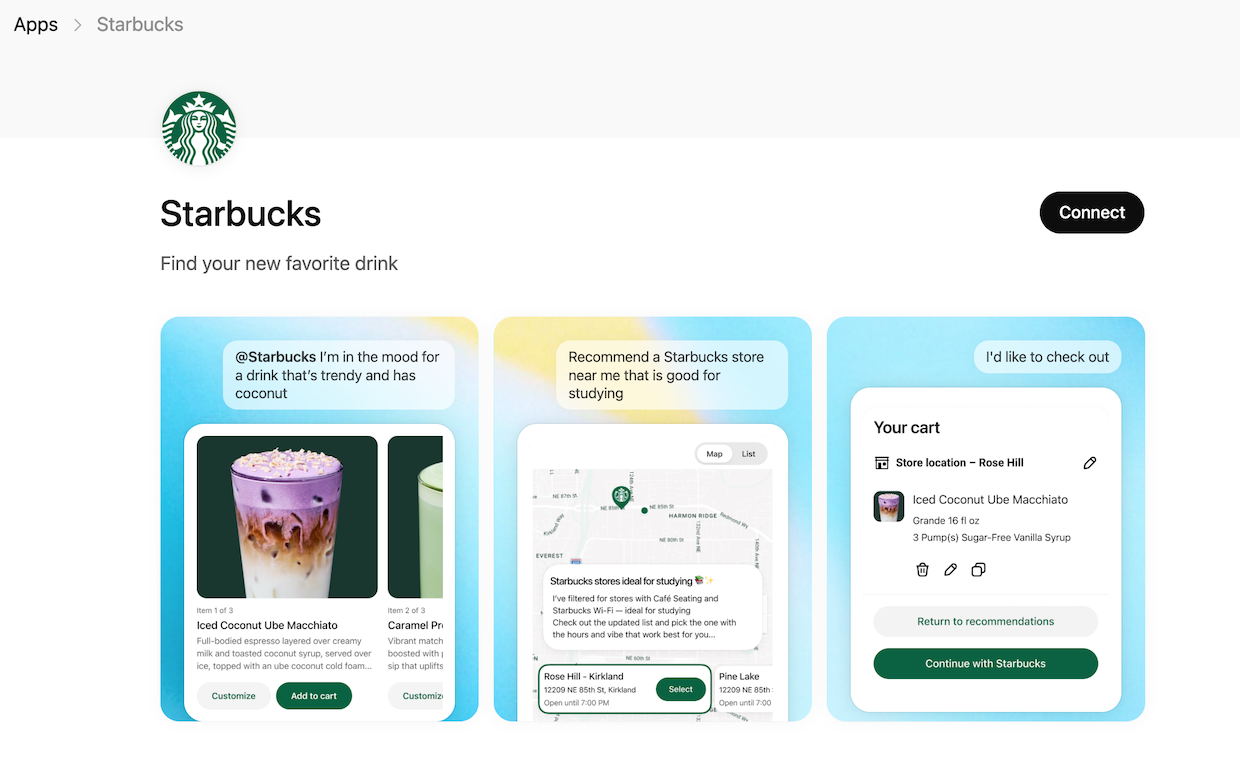
Screenshot of the Starbucks app in ChatGPT.
Starbucks is breaking new ground in the coffee industry’s use of generative AI, testing a ChatGPT integration that allows for what might be called vibe ordering.
Starting April 15, the Seattle coffee giant began testing a beta Starbucks app inside ChatGPT that lets customers describe a mood, a craving or a vibe — or upload a photo — and get drink suggestions to match. In Starbucks’ telling, the move responds to the idea that more customers are starting with a feeling, not a menu.
Users can tag @Starbucks in a ChatGPT conversation and get drinks tailored to their prompts. They can then customize the order and set a pickup location in ChatGPT, but must complete checkout through the Starbucks app or website, which keeps the purchases within Starbucks’ loyalty ecosystem.
Despite heavy investments in mobile ordering and loyalty platforms from competitors such as Dutch Bros, Dunkin’ and Luckin Coffee, Starbucks appears to be the first coffee chain to deploy a natural language AI, mood-based ordering tool. With the generative element, the Starbucks move goes one large ChatGPT-guided step beyond algorithm-driven, rules-based matching tools used by coffee sellers such as Trade Coffee and Atlas Coffee Club.

Beyond coffee, Starbucks is part of a broader retail experiment with generative AI. Big companies such as Walmart, Target, Etsy and Booking.com have all built similar AI-powered shopping or discovery integrations.
Salesforce said in July 2025 that 39% of consumers — and more than half of Gen Z — were already using AI for product discovery. Adobe, meanwhile, said 39% of U.S. consumers had used generative AI for online shopping, with millennials leading adoption at 46%. Adobe also found AI-driven traffic to U.S. retail sites jumped 1,200% from July 2024 to February 2025.
Beyond reaching customers, Starbucks is also rolling out a Microsoft Azure-powered barista assistant called Green Dot Assist, with piloting in 35 stores and a broader rollout expected to follow.
Accessible via in-store iPads, the system is designed to let partners ask questions — like how to build a seasonal drink, troubleshoot equipment or manage scheduling — using natural language. The company said the goal is to free up time that might otherwise be spent digging through manuals.
Comments? Questions? News to share? Contact DCN’s editors here. For all the latest coffee industry news, subscribe to the DCN newsletter.
Related Posts


Comment