

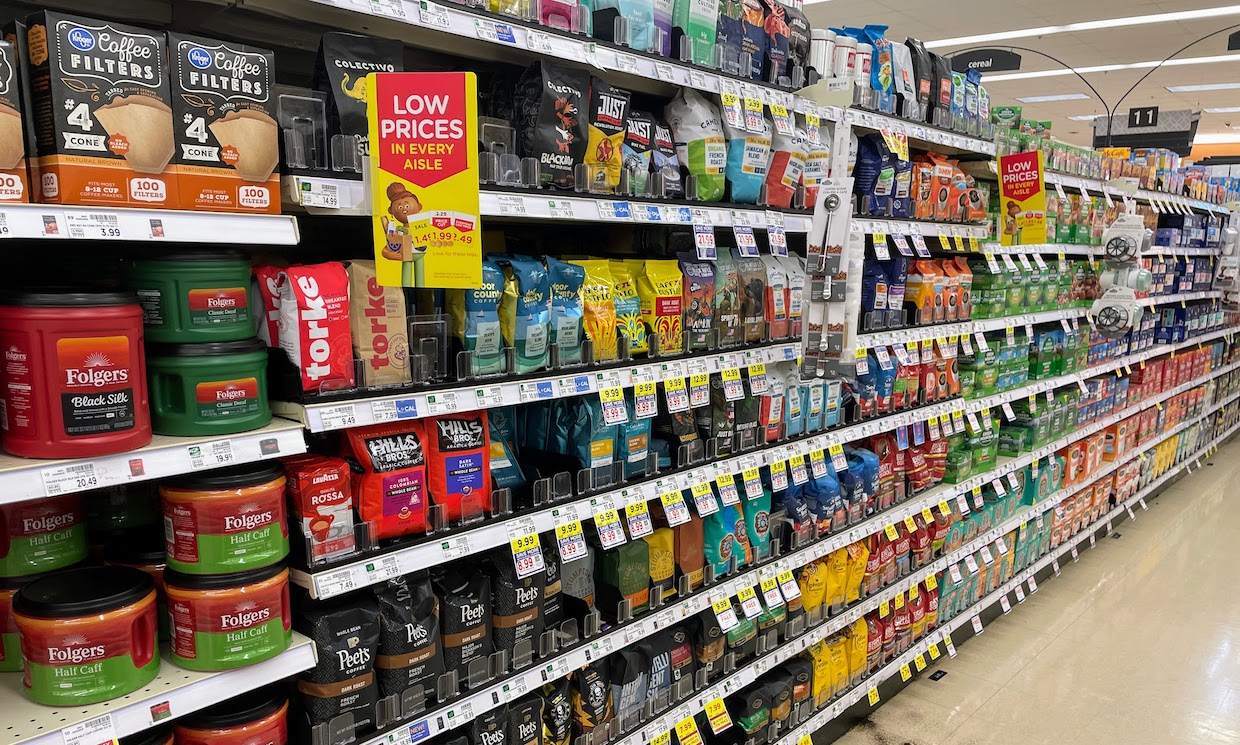
Coffee products competing with one another at a grocery store. Daily Coffee News photo by Nick Brown.
According to an oft-cited United Nations estimate, 40% of consumers say they’re willing to buy ethically produced goods, but only 4% actually do. Nearly two decades after that figure was first published, surveys show the pattern is essentially unchanged, according to the authors of a new study exploring “ethical premiums.”
The culprit, which may come as no surprise, is the typically higher price tag, according to research from two Canadian business scholars. Their proposed solution: less product, same shelf price.
Published late last year in the Journal of Business Ethics (Springer), the research explored the “ethical premium” through the lens of Fairtrade-certified coffee and other products tied to ethical consumption.
Through six experiments with 2,332 participants in the Netherlands, the United States and Canada, the researchers found that consumers were far more willing to buy the “ethical” products if they had the same sticker price as non-ethical counterparts, even if the volume was less.
The paper cites prior research that found “ethical” products typically cost 20% to 220% more than their conventional counterparts. At the point of purchase, that price difference activates what the study calls the “pain of payment” — the immediate, visceral discomfort of spending more money for an attribute that benefits someone else rather than the buyer directly.
“Price is immediate and hard to ignore,” co-author Mehak Bharti, assistant professor of marketing at Toronto Metropolitan University’s Ted Rogers School of Management, said in a university press release. “Even people with strong values struggle, because the cost feels immediate.”

The study proposes reframing the ethical premium not as a price difference but as a quantity difference, where the unit cost per gram for “ethical” coffee is higher, but the price on the bag is not.
In one experiment, 587 U.S. participants chose between a conventional coffee and a Fairtrade version that was 25% more expensive on a per-ounce basis. When the Fairtrade coffee was simply priced higher — $6.05 versus $4.95 for the same 12.2-ounce size — 49.2% chose it. When the Fairtrade coffee was instead reduced to 10 ounces and priced at the same $4.95 shelf price as the conventional bag, 60.7% chose it. A separate version of the same test, using a larger conventional bag at the higher shared price, produced a similar lift for the ethical option.
“Paying a higher cost hurts more than getting a little less,” Bharti said. “When the shelf price is the same, shoppers don’t feel penalized for doing the right thing.”
The researchers sought to distinguish this strategy from “shrinkflation” — the practice of quietly reducing product size while keeping prices and packaging identical, essentially passing cost increases to consumers without them noticing.
The study’s approach involved transparency, with quantity and price clearly displayed side by side, with unit prices shown.
“In our research, rather than obscure quantity differences, we present ethical options in visibly smaller quantities,” the study states. “Consumers are able to directly compare the (lower) quantity and (same) retail price of ethical products with their conventional counterparts. Framing the ethical premium as a quantity difference rather than a price difference allows consumers to prioritize their ethical intentions over price considerations, potentially narrowing the gap between ethical attitudes and behaviors.”
The study was authored by Bharti and corresponding author Jing Wan of the University of Guelph. The authors declared no competing interests.
Comments? Questions? News to share? Contact DCN’s editors here. For all the latest coffee industry news, subscribe to the DCN newsletter.
Related Posts


Comment