


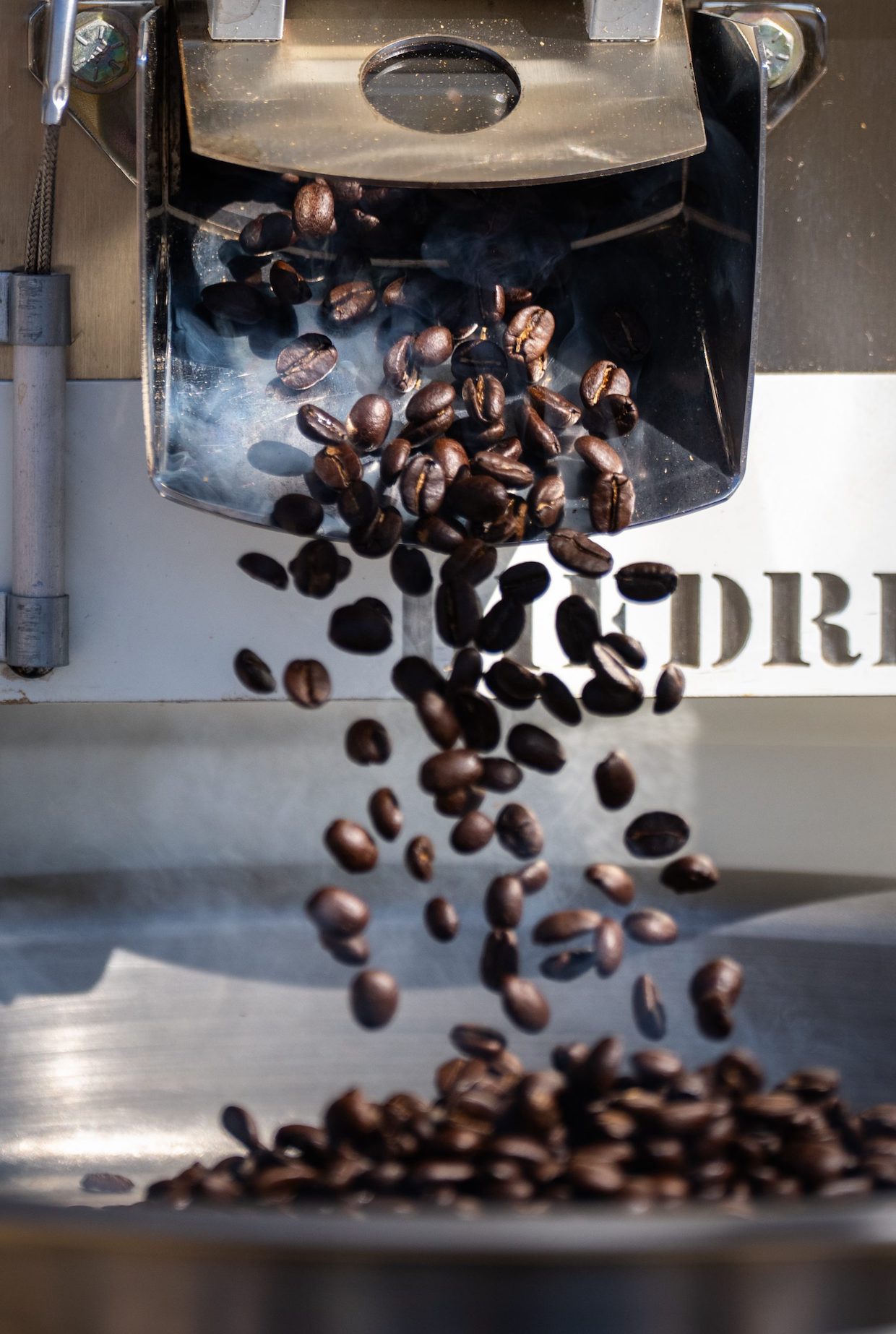
Sandia National Laboratories photo by Craig Fritz.
A state-funded solar-powered coffee roasting experiment in New Mexico is pointing toward a novel possibility in commercial roasting: retrofitting existing drum roasters to use stored solar energy for heat inside the roasting drum.
The system, recently tested at Sandia National Laboratories with longtime Albuquerque-based roasting company Michael Thomas Coffee, uses photovoltaic energy stored as heat in a bed of rocks, then releases that heat into a roasting drum.
In tests, the system reportedly roasted coffee to light, medium and dark levels while reaching temperatures as high as 600 degrees Celsius. Sandia described the project as a proof-of-concept for commercial coffee roasting, suggesting the system could greatly reduce reliance on natural gas in traditional drum roasters.
“It’s not learning a new roasting machine. It’s working with your current roaster that you know extremely well and just adapting to a different energy source,” Michael Thomas Coffee Owner Michael Sweeney said in a news release from Sandia. “This is going to let me look at roasting literally in a different light and look at my craft from a different viewpoint.”
From Chiles to Coffee
Sandia systems engineer Ken Armijo described the concept as “indirect solar heating.” Electricity generated by photovoltaic panels is converted into heat and stored in a radial packed-bed system filled with rocks. When needed, that stored energy is released as heat inside the roasting drum.
The experiment followed Sandia testing in 2022 involving green chile roasting. In the coffee test, Sandia said the system cut roasting time by a few minutes for the dark roast. In the earlier experiment, concentrated sunlight cut green chile roasting time in half and produced more uniform roasts than traditional gas-fired roasting, according to Sandia.
The solar system also allowed the coffee roaster to be preheated and cooled more quickly between batches, which Sweeney noted could meaningfully increase daily output.
Another potential advantage of the rock-bed storage system is that it can hold heat for extended periods — potentially for days — meaning the system could support roasting even when the sun is not shining. Albuquerque was identified as a natural fit for the project, given its approximately 300 sunny days per year.
Commercializing the Retrofit
For roasters, the practical promise is a retrofit. Sandia said the project aims to develop a bolt-on solution for existing natural gas-fueled roasting machines, allowing roasters to use stored solar thermal energy without replacing the entire machine.
The work is being funded through New Mexico’s Technology Readiness Gross Receipts Initiative, or TRGR, which supports New Mexico businesses working to move lab technologies toward commercial use. The Michael Thomas Coffee project is also part of a Cooperative Research and Development Agreement, a formal mechanism for Sandia to collaborate with private companies.
The solar coffee roasting experiment involved Sandia thermal-storage technology covered in U.S. Patent No. 11,549,761.
“My goal is to get this industrial heat and energy storage system into the hands of someone who can commercialize it,” Sandia licensing and business development specialist Bob Sleeper said.
Comments? Questions? News to share? Contact DCN’s editors here. For all the latest coffee industry news, subscribe to the DCN newsletter.
Related Posts
Nick Brown
Nick Brown is the editor of Daily Coffee News by Roast Magazine.

Comment