


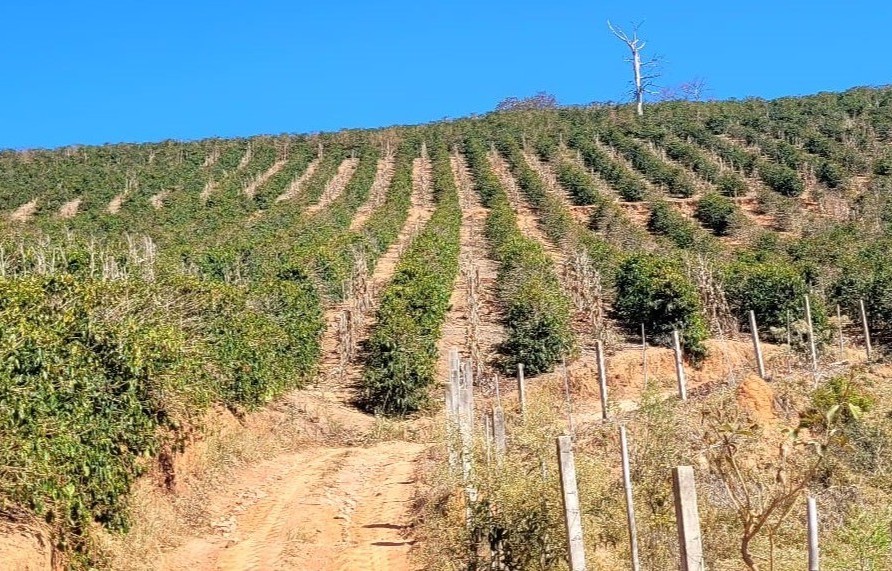
Photo by Jonas Ferraresso.
Another year has passed for coffee in Brazil, and the 2025 crop is now virtually 100% picked, in storage and ready for commercialization.
I’d like to take this opportunity to share some observations about the 2025 and 2026 crops, based on many first-hand visits to coffee fields in Minas Gerais and São Paulo, and from hours of conversations with technicians, farmers, researchers, warehouse owners and agronomists throughout the Brazilian coffeelands.
The 2025 Brazil Crop
Let’s start with 2025. It’s important to note that the formation of an arabica crop in Brazil begins practically two years before its harvest, and any disruption along that two-year journey affects productivity.
Backtracking to August/September 2023, there were periods of extensive rainfall that, combined with high temperatures, triggered the growth of plagiotropic and orthotropic branches that would later support the blossoms expected in 2024. Around April and May of 2024, judging by the number of branches, productive nodes, plant health and leaf coverage, it seemed likely we would have good conditions for the flowering that was set to occur between August and October. At that point, I thought we might see a bountiful harvest in 2025.
Unfortunately, between May and September of 2024, we faced a record-breaking drought that severely affected fruit set. Technicians and agronomists estimated that by May, much of the potential was already lost and that 20–25% of the harvest was compromised.
This happens because the energy reserves maintained by coffee plants drain when fueling natural physiological processes such as leaf and root growth, flower and fruit development, pathogen defense and so on. Under stress — whether climatic or physiological — the plant spends part of that energy balance just to survive until conditions improve.
In some cases, like in 2024, the flowering can even appear intense because under stress the plant’s physiological response may be “one last massive bloom before dying.” It’s a survival mechanism — a way to perpetuate the species. However, this does not usually translate into higher production. Low reserves mean the plant cannot sustain such an abundant bloom, and most flowers fall to the ground. That was a common sight in 2024.
From October 2024 to February 2025, however, rainfall was fairly regular and average temperatures were not too high, unlike the hot spell of January/February 2024. As a result, the remaining fruits developed well, and new branches — responsible for carrying the 2026 harvest — grew vigorously.
Between February and March 2025, a dry spell left key arabica regions without rain for 20–30 days, trimming the final grain-filling stage and producing lighter, less-dense beans. Surveys then suggested a further 5% reduction on top of the 20% potential loss already expected — a decline confirmed in the current harvest by below-average cherry-to-green yields. Many arabica regions required more seeds than usual to fill a standard bag, underscoring the density drop.
This short drought also hampered branch growth and the accumulation of energy reserves for 2026. Today, warehouses across different regions show smaller stocks than usual — a fact anticipated by local analysts, though still surprising for part of the market.
Balancing Energy Reserves
Why am I emphasizing energy reserves so much? Because they are vital for shaping the harvest.
In Brazil’s main arabica regions, we have two distinct periods each year. From August to March/April, plants grow and accumulate reserves, thanks to abundant rains and higher temperatures. It’s worth remembering that arabica performs best between 21–22°C and up to 30–31°C. Below or above these thresholds, physiological and photosynthetic processes are less efficient. So when conditions are good, that’s the time for the coffee tree to grow and prepare for the tougher months ahead.
Between April and August, temperatures and rainfall drop. During this period, the plant barely grows or stores energy. Still, thanks to reserves accumulated earlier, it usually gets through this mild stress period. The problem comes when external factors increase energy expenditure, leaving the plant with a near-empty fuel tank just as the rainy season begins.
Heading Into 2026
Now let’s talk about the 2026 harvest. Despite the challenges of the early-year drought, the outlook around May 2025 was still positive, with the potential to finally surpass the 2020 harvest.
However, midyear has been harsh on arabica fields. Frost hit some important areas in the Cerrado of Minas Gerais — not as severe as in 2021, but still with noticeable damage. We’ve also seen cold waves with high humidity at the beginning of the dry season, which increased leaf-loss diseases. And now, another prolonged drought coupled with rising temperatures is worsening defoliation and draining the energy reserves built up in early 2025.
Unfortunately, as I drive through the arabica regions of Brazil’s two largest producing states, it’s difficult to imagine the 2026 crop surpassing 2020.
Climatic challenges remain the greatest barrier to overcome. Many Brazilian producers are well aware of technologies and management practices that can improve production resilience — agroforestry systems, drought-tolerant varieties, boosting soil organic matter, green manures and cover crops, irrigation and others.
Over the last five years, I’ve seen enormous investment in these approaches. Yet the pace of adoption still cannot keep up with the scale and speed of the climate challenges farmers are facing.
Publisher’s note: Daily Coffee News does not engage in sponsored content of any kind. Any statements or opinions expressed belong solely to the authors and do not necessarily reflect the views of Daily Coffee News or its management.
Comments? Questions? News to share? Contact DCN’s editors here. For all the latest coffee industry news, subscribe to the DCN newsletter.
Related Posts
Jonas Ferraresso
Jonas Leme Ferraresso holds an agronomy degree from São Paulo State University (UNESP). He has worked as a coffee farmer, a coffee agronomist and as an advisor for several farms in Brazil.



Comment