


A sealed container and a dose of carbon dioxide may be enough to nudge certain natural-process coffees into higher-end specialty coffee territory, according to a new Colombian study that compared open-air and CO2-assisted “closed fermentation” techniques.
Researchers from Colombia’s Servicio Nacional de Aprendizaje (SENA) and Universidad del Valle tested five approaches to fermenting whole coffee cherries from the same lot before drying, then evaluated the roasted coffee using the Specialty Coffee Association’s legacy 100-point cupping protocol.
In the best-performing treatment, a 24-hour CO2 “modified atmosphere” fermentation, the coffee averaged an 86.90 final score, compared with 82.15 for an unfermented control.
In the study, published in December 2025 in the Scientific World Journal, the authors suggest the trials could help form a framework for more repeatable and scalable strategies in a part of the specialty market that is often driven by small-scale experimentation.
“Despite advances in coffee fermentation research, most studies have been conducted under laboratory-controlled or wet fermentation conditions, limiting their applicability to natural (dry) processing systems,” the authors wrote. “There is still scarce empirical evidence on how modified-atmosphere fermentation, particularly with CO2, affects the chemical and sensory quality of dry-processed coffees under real production settings.”
Studying ‘Controlled Fermentation’
Controlled, closed fermentations are increasingly common in premium coffee production, yet the science around what improves cup quality tends to lag behind the pace of innovation.
The authors of this study said it links a simple modified-atmosphere setup to measurable gains in SCA scores for natural-process coffee, while also tying parts of the chemical profile — sugars and fatty acids — to sensory outcomes under real production conditions on a working farm.

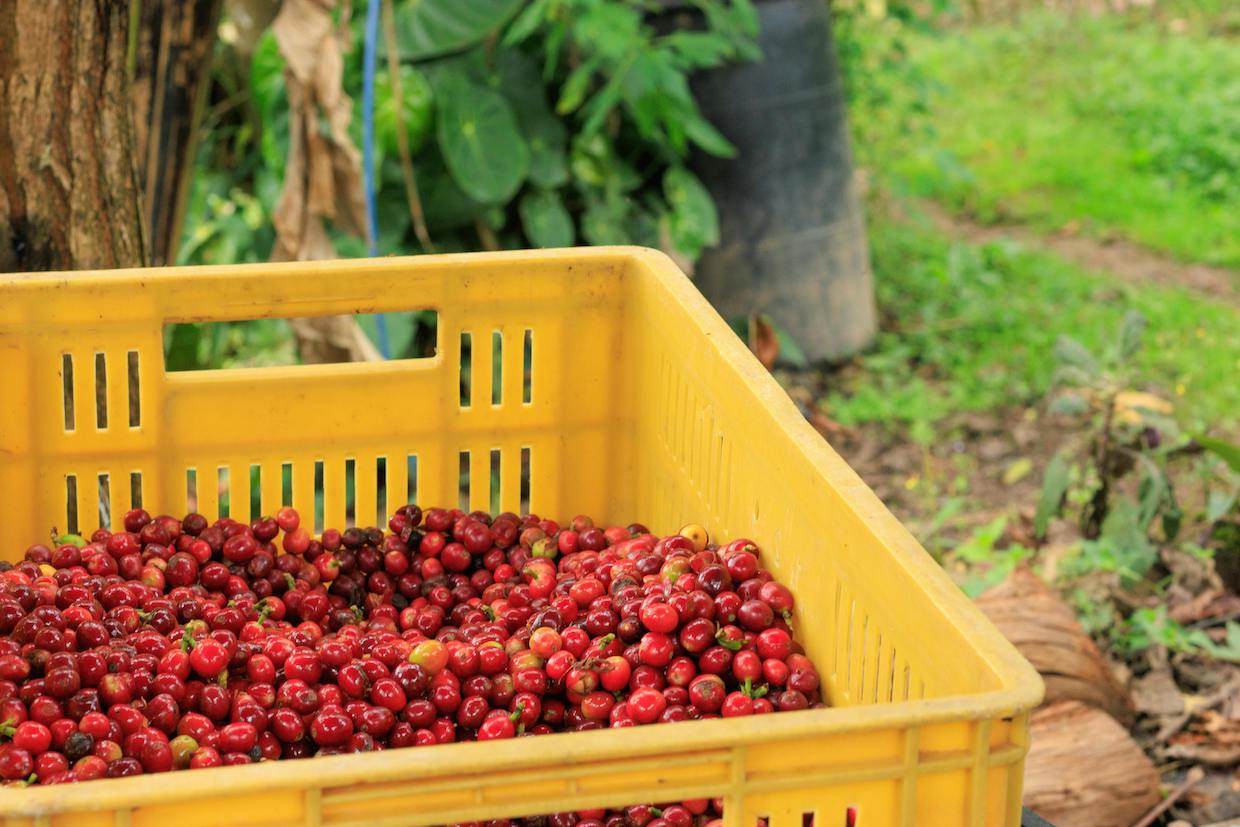
Initial processing of red coffee cherries cv. ‘Colombia’. Harvesting at a ripening Stage 5–6 (a) and after flotation (b). Shared via CC BY 4.0. See the original here.
The arabica coffee used for the study was a Colombia cultivar from a farm in El Águila, Valle del Cauca. The team ran five treatments: a control with no fermentation, open-air (“aerobic”) fermentation for 24 hours and 48 hours, and sealed-container fermentation under CO2 for 24 hours and 60 hours.
For the CO2 treatments, they displaced air in sealed containers using CO2 generated on-site, reporting 20 liters of CO2 produced by reacting 80 grams of sodium bicarbonate with 1,000 milliliters of 5% acetic acid. After fermentation, the cherries were dried and later cupped by three certified Q-graders using the SCA protocol.
What They Found
On the score sheet, the study found that all treatments resulted in uniformity, a clean cup and the presence of sweetness, with none of the methods producing obvious defects.
Where the coffees separated was on core quality drivers such as fragrance/aroma, flavor, acidity, body, balance and the overall final score. The two CO2 treatments produced the highest average final scores at 86.90 and 86.50, while the control averaged 82.15. The open-air ferments landed in between, at 84.70 (24 hours) and 85.10 (48 hours).
On the chemistry side, the researchers reported that sugar use during fermentation differed by method, with CO2 tending to slow the consumption of sucrose in the 24-hour CO2 treatment. They also reported that fermentation did not significantly change chlorogenic acid overall, although the lowest levels showed up in the open-air treatments.
The research drew data from one coffee lot and a single panel of three Q Graders. While the authors called for broader chemical analyses in future work, they suggest CO2-controlled fermentation in the post-harvest processing phase of “naturals” can be a significant tool among producers seeking to boost quality scores.
“Unlike previous research mainly focused on laboratory trials or wet fermentation systems, with this work it is possible to show how controlled CO2 has an influence on natural coffee quality,” they wrote. “The findings will broaden the current understanding of fermentation biochemistry in dry-processed coffees and offer practical guidance for producers seeking to standardize natural profiles and reduce quality variability in the field.”
Comments? Questions? News to share? Contact DCN’s editors here. For all the latest coffee industry news, subscribe to the DCN newsletter.
Related Posts



Comment