



A Pipp 64 at World of Coffee San Diego. Daily Coffee News photo by Howard Bryman.
A versatile commercial brewing system called Pipp — which references percolation, immersion and positive pressure — is emerging from the rugged range of western Wyoming.
Capable of espresso, tea, immersion-brew coffee and more, the system was created by Cody Hamilton, founder of Pinedale, Wyoming-based roastery cafe Pine Coffee Supply and a new equipment company called Visual Engineering.
The inaugural Pipp products (styled “PIPP” by the brand) are the the Pipp 01 single-cup brewer and Pipp 64 batch brewer. Both were introduced at World of Coffee San Diego last month.
(Read all of DCN’s World of Coffee San Diego coverage.)
The boilerless, vertically oriented countertop systems center on cylindrical borosilicate glass brew chambers with a portafilter attached underneath. The Pipp 01 accepts standard 58-millimeter portafilters. The Pipp 64’s custom portafilter, measuring 124 millimeters in diameter and 42 millimeters deep, accepts the paper filters made by NextLevel for the Pulsar brewer.

The Pipp 64 custom portafilter. Daily Coffee News photo by Howard Bryman.
The four brewing variables programmable by Pipp users are water volume, water temperature, infusion time and air pressure. Water filling the chamber can percolate gently through medium- or coarse-ground coffee for a drip-style brew, either by gravity alone or under gentle pressure.
Pipp 01
The standard Pipp immersion process includes two steep-and-release passes of fresh water through either coffee or tea. After water is added, a valve at the top of the chamber seals shut to suspend the slurry via vacuum pressure, akin to the physics of an upright AeroPress brewer. The valve then opens to release the brew.
For espresso, a barista preps any 58-millimeter basket, then places a puck screen on top for even water dispersal. Low-pressure preinfusion occurs as a precise volume of water fills the chamber, after which a built-in air compressor pressurizes the column to push water through the bed.

Pipp 01 brewers. Courtesy photo.
“It kind of replicates a lever in that way,” Cody Hamilton told Daily Coffee News. “It’s got to build the pressure, and then as it’s pushing through it’s got to maintain it, so it’s constantly filling that chamber, then it starts to taper off a little at the end. It’s going to be different from other espressos, but it still produces crema if you want it.”
Hamilton is also excited by Pipp’s potential as a “soup” machine, referencing a trendy approach involving a grind coarser than espresso, a roughly 4:1 water-to-coffee ratio, near-zero-pressure pre-infusion and a rapid low-pressure extraction finishing in roughly 25-30 seconds.
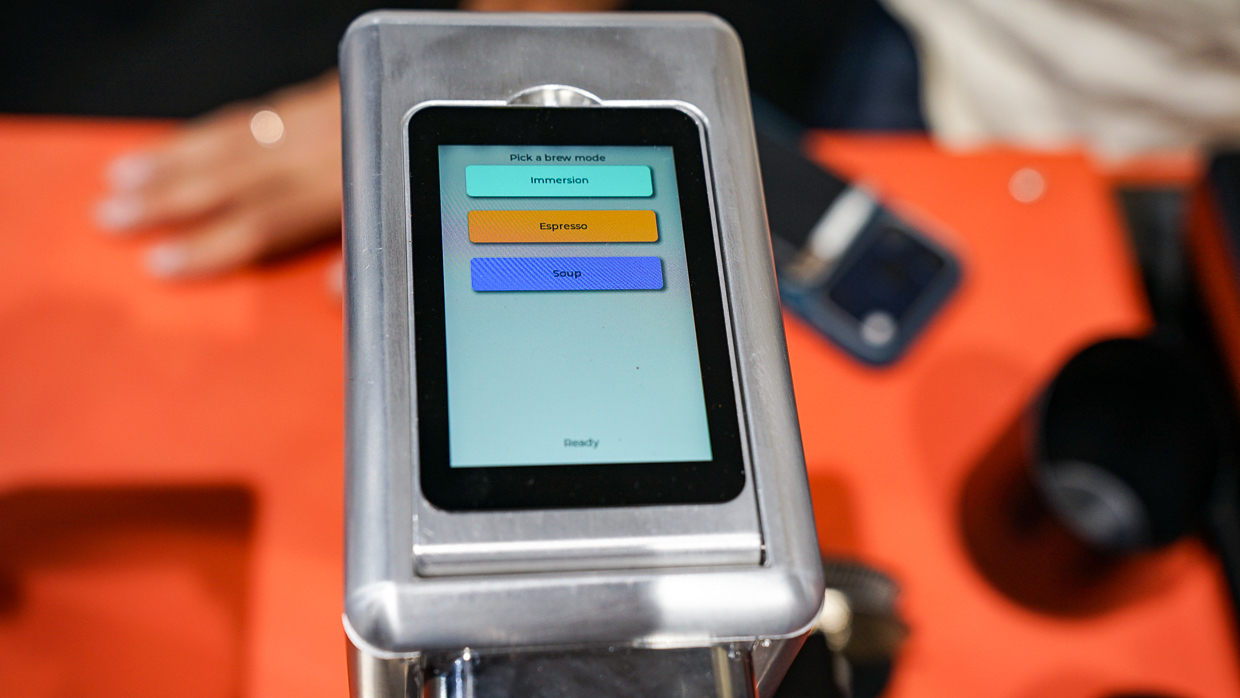
Daily Coffee News photo by Howard Bryman.
Pipp 64
The 64 performs the same brew profiles as the 01, but on a larger scale, brewing up to 64 ounces of ready-to-drink immersion brew or 32 ounces of espresso. Cold brew, with or without a hot bloom phase, is also programmable, and Visual Engineering is exploring a laser-cut built-in filtration plate for performance similar to a traditional portafilter basket.
The final production model will have magnetic side panels that allow operators to access all parts inside the relatively simple machine. All fittings are push-connect, and Hamilton said there are essentially eight internal components apart from the chipset.
“I’ve seen a lot of really cool machines, but they always seem to have too many parts,” Hamilton said. “We wanted to take away as much as possible.”
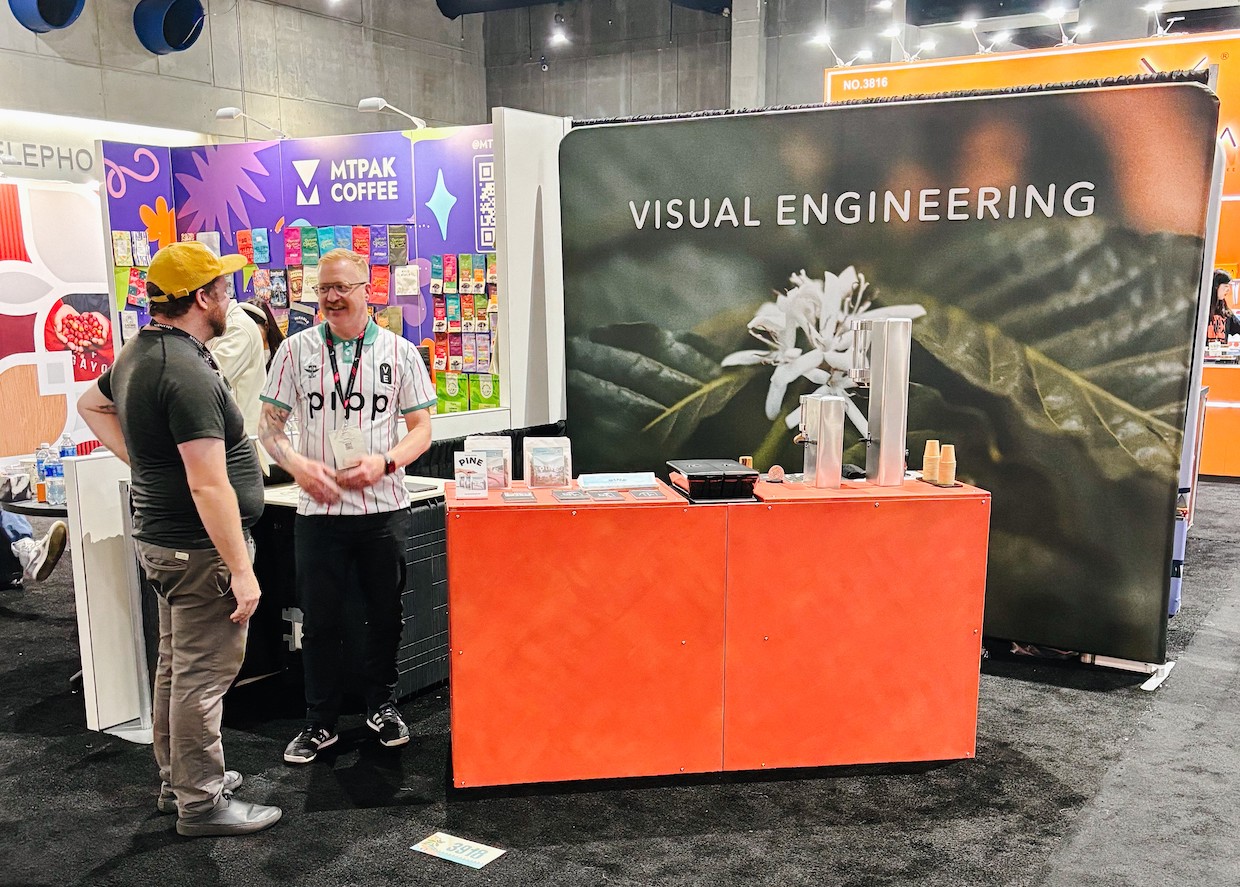
Pipp creator and Visual Engineering founder Cody Hamilton (right) in San Diego.
Necessity became the mother of invention in late 2023. Hamilton had only begun tinkering with the Pipp’s design when the brand-new espresso machine inside Pine Coffee Supply‘s second location, in Boise, Idaho, went down.
“There were no techs in the area that could work on it,” Hamilton said. “It took nine months to get it fixed. I had to buy another whole espresso machine that took three weeks to get freighted to us. We were out a whole month of labor, rent, income, and that shop has never fully recovered. Once that happened, I was like, I’ve got to go all in on [Pipp].”
Getting to Pipp
At first glance for many specialty coffee professionals, the Pipp may be visually reminiscent of the glass-chambered Steampunk brewing system made by Alpha Dominche from 2012 until the company ceased operations in 2018. The functional differences, however, are significant, as the boiler-fed, steam-driven Steampunk worked more like an automated siphon brewer.
In designing the Pipp, Hamilton said he was more specifically inspired by the semi-automated mechanics of the weighted-plunger-driven Trinity One brewer, which was made by Australian company Trinity Coffee following a 2015 Kickstarter but has since been discontinued.
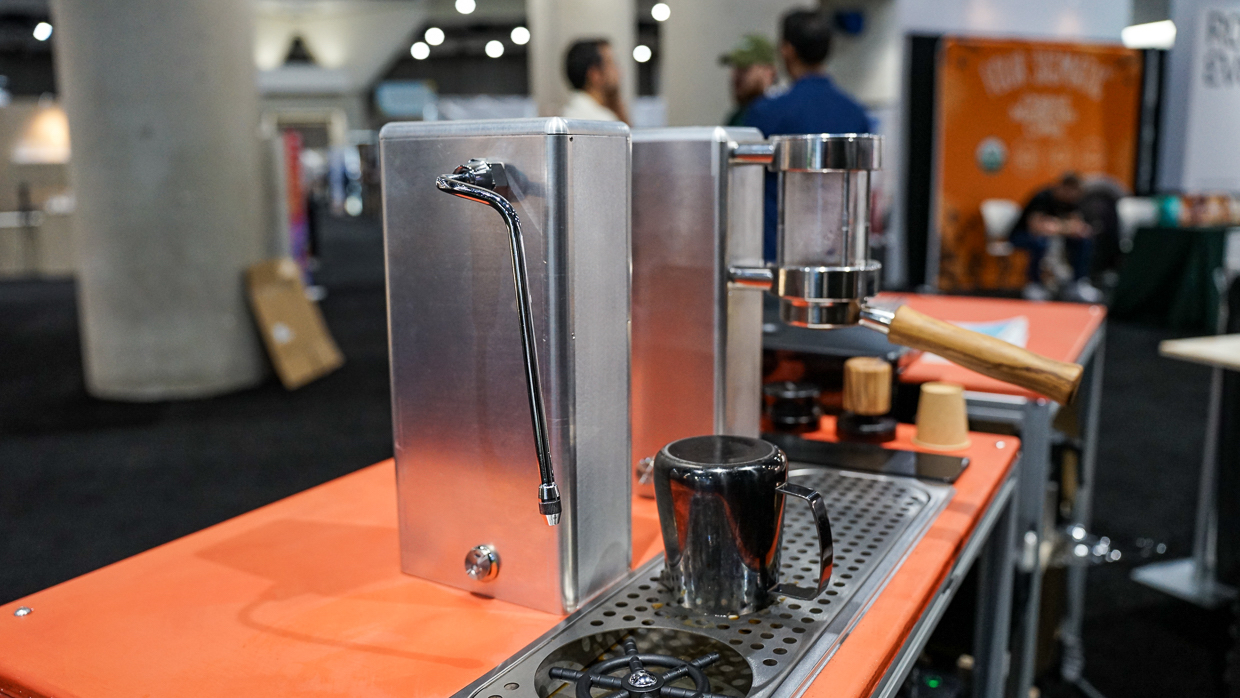
Daily Coffee News photo by Howard Bryman.
“I used to retail them back before COVID,” Hamilton said of the Trinity brewers. “I wanted a way to do that, but not manually, because we’re very short on staff out there [in Wyoming].”
Visual Engineering
Hamilton said Visual Engineering is an independent company funded largely out of pocket, with support from a small group of investors.
Wi-Fi and Bluetooth control, monitoring and networking features are still in development, as is a dedicated flash-heated steam unit for manually steaming milk for espresso drinks.
Machines will be assembled by a small team at Pine Coffee Supply’s Wyoming roasting facility and shipped in hard plastic cases. Hamilton plans to price the Pipp 01 competitively with other high-tech commercial single-group espresso machines and have both Pipp systems ready for preorders by early next year.
“Definitely by next [U.S. World of Coffee] expo, we plan to have all three machines fully ready to go,” Hamilton said. “We want to have an experiential booth next year where we’re just watching people use them and kind of guiding them through it.”
Comments? Questions? News to share? Contact DCN’s editors here. For all the latest coffee industry news, subscribe to the DCN newsletter.
Related Posts
Howard Bryman
Howard Bryman is the associate editor of Daily Coffee News by Roast Magazine. He is based in Portland, Oregon.



Comment