

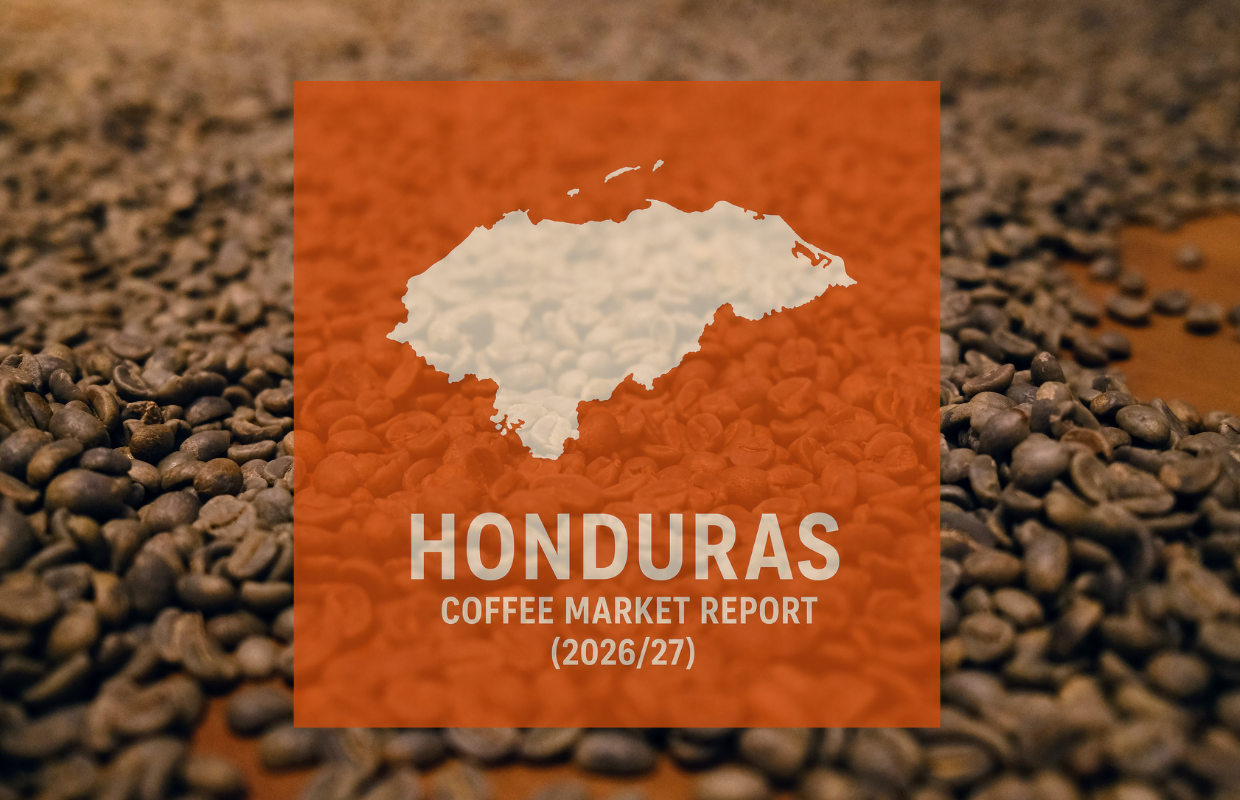
Green coffee production in Honduras is forecast to climb to 6.03 million 60-kilogram bags in market year 2026/27, a 9% increase tied to improved plant nutrition, favorable biennial production cycles, expanded productive area, better crop management and maturing plantations, according to the latest USDA Foreign Agricultural Service annual report.
Prepared by the USDA FAS office in Tegucigalpa, the report forecasts exports rising to about 5.50 million 60-kilogram bags. Domestic consumption is also forecast higher, while ending stocks are expected to build as production outpaces use and exports.
[Note: This is part of an ongoing series of DCN stories that explore USDA FAS country-level coffee reports, which are produced by different authors and field offices around the world.]
Production on the Rise
Honduran coffee production is forecast at 5.53 million bags in 2025/26, up 6.3% from 5.20 million bags in 2024/25. The 2026/27 forecast anticipates another gain, bringing production above 6 million bags for the first time since 2021/2022, according to past FAS reports.
Harvested area is forecast to rise from 310,000 hectares in 2025/26 to 330,000 hectares in 2026/27. Bearing trees are forecast to increase from 2 billion to 2.1 billion, while total planted area is forecast at 360,000 hectares.
Honduras remains an arabica-focused producer, with no robusta production listed in the USDA FAS commodity balance sheet. Production remains concentrated in six major regions: Copán, Montecillos, Opalaca, Comayagua, El Paraíso and Agalta.
The Honduran coffee institute IHCAFE said growth is being supported by improved plant nutrition, pruning, crop management and newly established plantations reaching maturity. Yet coffee leaf rust remains a concern. As of March 2026, national average rust incidence rose from 7.57% to 8.44%.
Exports Climb, U.S. Still Top Buyer
Honduran coffee exports are forecast to rise from 5.03 million bags in 2025/26 to about 5.50 million bags in 2026/27, with green coffee representing nearly that entire volume.
As of April 2026, Honduras had exported 3.17 million bags, up 38% from the same period in 2024/25. Export value rose 33% to $1.39 billion, even as the average export price fell 2.7% to $439.47 per bag.
The United States remained the leading buyer of Honduran green coffee in 2025, accounting for 34% of exports, followed by Germany at 23% and Belgium at 13%, according to Trade Data Monitor figures cited in the report.
Stocks and Policy Take on Greater Weight
Ending stocks are forecast to rise sharply, from 435,000 bags in 2025/26 to 707,000 bags in 2026/27, as production is expected to outpace exports and domestic consumption.
Policy support remains focused on global competitiveness, renovation and climate resilience. IHCAFE is providing technical support tied to the European Union Deforestation Regulation (EUDR), while its “Renew without Stopping Production” program is designed to renovate aging coffee areas, improve productivity and support 33,000 producers.
The report noted a possible shift in Honduras’ market position for “differentiated coffee,” or coffees that tend to hold higher market value due to factors such as certifications or high quality scores.
After holding relatively steady from 55% of green coffee exports in 2020/21 to 52% in 2024/25, differentiated coffees represented just 37% of exports in preliminary 2025/26 data. FAS said final data will be needed to determine whether the drop reflects shipment timing, production challenges affecting early-season quality or other market dynamics.
Comments? Questions? News to share? Contact DCN’s editors here. For all the latest coffee industry news, subscribe to the DCN newsletter.
Related Posts

Comment