

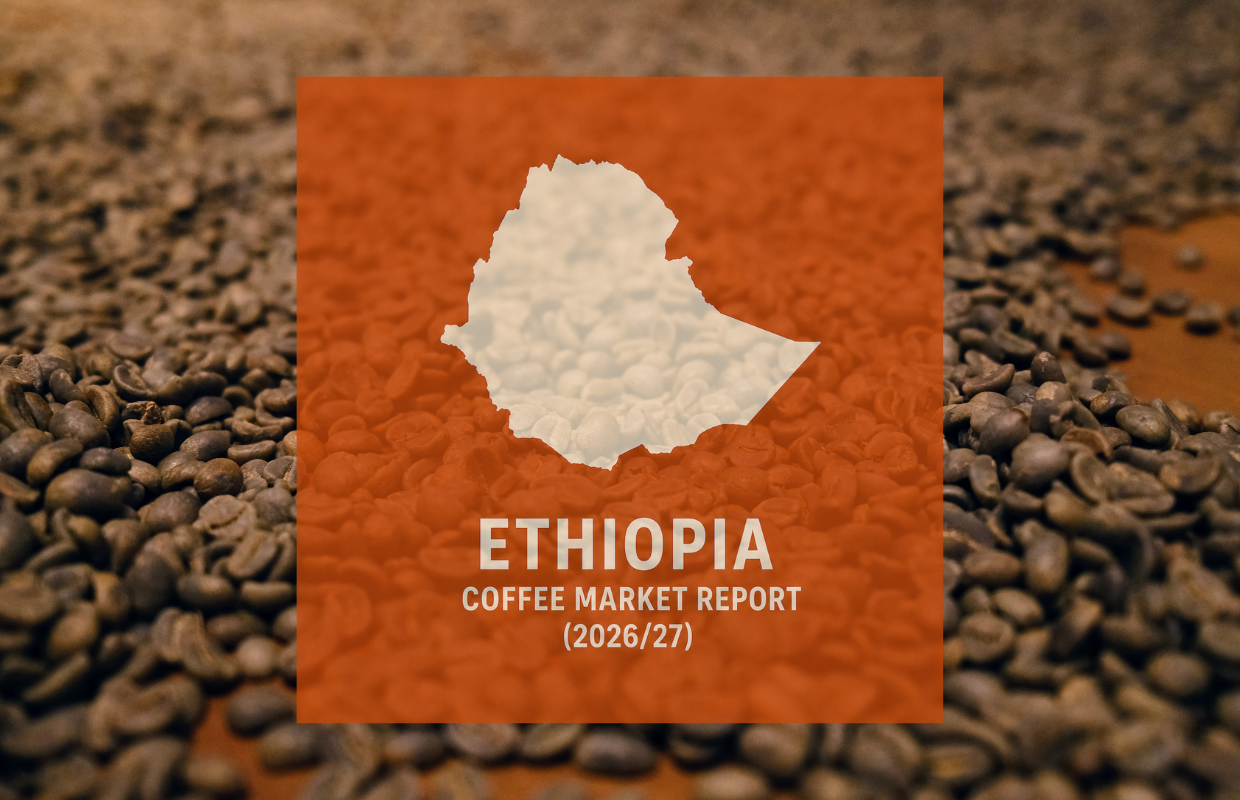
Ethiopia’s green coffee production is forecast to rise 4.7% to 12.1 million 60-kilogram bags in market year 2026/27, with improved yields, modest area growth and favorable weather conditions, according to the latest USDA Foreign Agricultural Service annual report.
The report forecasts exports rising 2.4% to 7.13 million 60-kilogram bags, with China rapidly emerging as one of Ethiopia’s top coffee buyers due in part to tariff-free market access. The Ethiopian government is also leading significant efforts toward traceable and modernized production, while encouraging foreign investment.
[Note: This is part of an ongoing series of DCN stories that explore USDA FAS country-level coffee reports, which are produced by different authors and field offices around the world.]
Production On the Rise
The 2026/27 forecast would put Ethiopia’s production above the 11.56 million bags estimated for 2025/26 and the 11.46 million bags estimated for 2024/25. Harvested area is forecast to rise 1.3% to 800,000 hectares. The country predominantly produces arabica coffee.
The report said April 2026 field reports showed healthier flowering and more even cherry development across key producing regions, while southern regions are expected to rebound after a lower 2025/26 harvest.
The Ethiopian Coffee and Tea Authority, the government agency overseeing the coffee sector, reported that 5.9 million farmers are engaged in coffee production. Smallholder farmers account for about 90% of national production, often growing coffee on less than half a hectare.
Stumping and New Seedlings Support Output
FAS said productivity gains are being supported by pruning, stumping of older trees, composting, soil management and gradual adoption of improved seedlings. About 70% of Ethiopia’s coffee trees are old, with some estimated to be more than 100 years old.
The report said 15% of harvested area in 2025/26 was covered by stumped trees. Studies in Sidama and South Ethiopia found that stumped trees can increase yields up to threefold within four years.
The Ethiopian Agricultural Research Institute, the national agricultural research body, has distributed more than 50 improved coffee varieties with higher yields and stronger disease resistance.
Exports Rise Despite Cost Pressure
Exports are forecast at 7.13 million bags in 2026/27, including 7.1 million bags of green coffee and 30,000 bags of roasted coffee.
The 2025/26 export estimate was revised down to 6.97 million bags from an earlier projection of 7.8 million bags. FAS said record-high cherry prices locally, lower international prices and rising operating costs have reduced export incentives, with some farmers and exporters now holding stocks in hopes of better prices.
Domestic consumption is forecast to rise 11.1% to 5 million bags, supported by Ethiopia’s deep coffee culture, urban cafe growth, population growth and younger consumers.
The Emergence of China
Ethiopia’s 2024/25 coffee exports reached 7.43 million bags, valued at $2.89 billion. That represents an increase of 31.9% in volume and 69.4% in value from the prior year. Saudi Arabia and Germany remained the top two markets, while China rose to third, followed by Belgium and the United States.
Exports to China surged 264.1% to 670,000 bags in 2024/25, reflecting trade promotion, stronger commercial links, tariff-free access and the growth of China’s coffee market. The report said China ranked 17th among Ethiopia’s coffee destinations just a decade ago.
Policy and Foreign Investment
The Ethiopian government has allocated 100,000 hectares for private-sector coffee development, marking the first time large tracts of land have been set aside exclusively for modern coffee production. If fully developed, the area would expand Ethiopia’s commercial coffee farm base by about 70%, adding mechanized planting, irrigation, improved varieties and modern equipment alongside the country’s smallholder-dominated system.
At the same time, Ethiopia is tightening control over its coffee trade. The Ethiopian Coffee and Tea Authority is building a national traceability system for EU deforestation rules, while new regulations require exporters to show stronger financial backing. The government is also allowing vetted foreign companies to export raw coffee directly, signaling a push toward more formal, traceable and better-financed export channels.
Comments? Questions? News to share? Contact DCN’s editors here. For all the latest coffee industry news, subscribe to the DCN newsletter.
Related Posts



Comment