


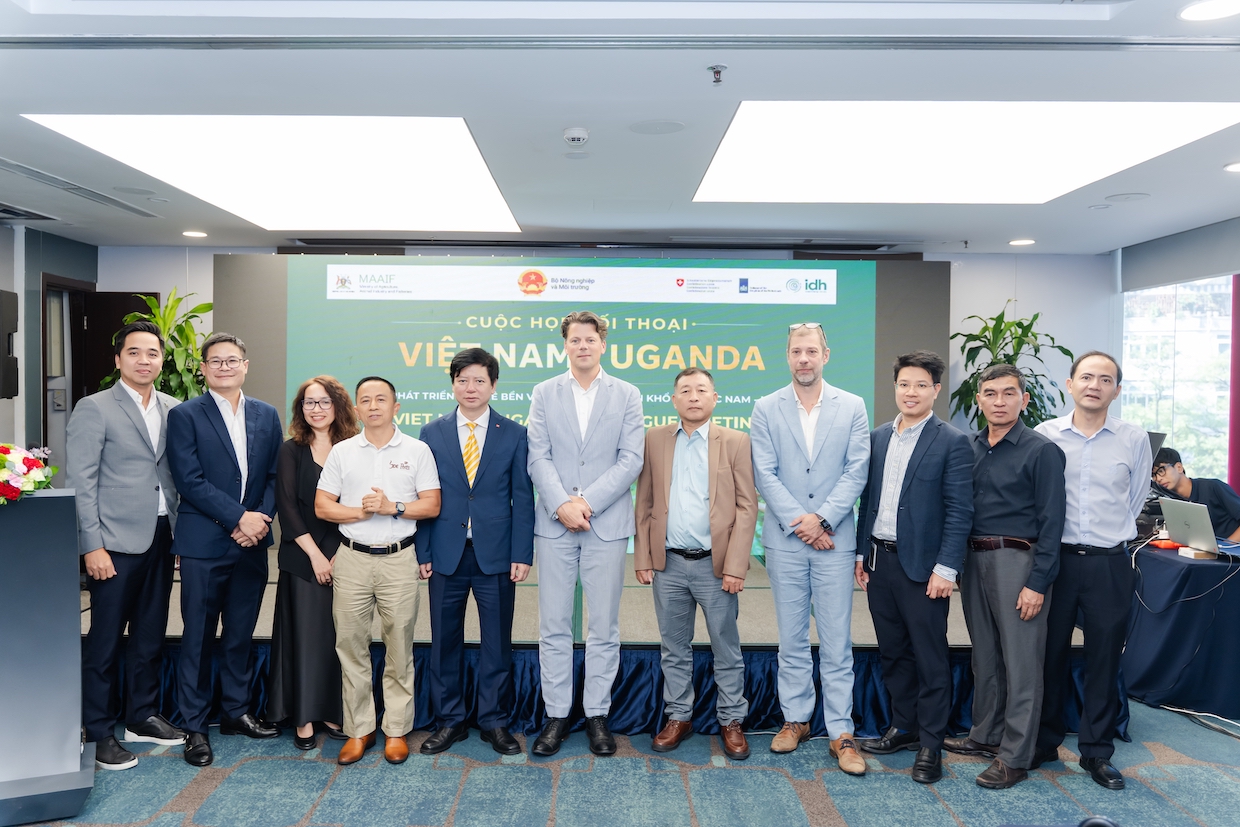
At the RCP launch. IDH press photo.
The Netherlands-based Sustainable Trade Initiative IDH has launched a four-year program designed to promote what it called a regenerative and verifiable coffee supply chain across four major producing countries.
Announced at a sustainable coffee roundtable in Hanoi, Vietnam, on Aug. 11, the Resilient Coffee Program (RCP) is designed as a pre-competitive investment platform with the ambitious goal of reaching 300,000 farmers by 2030.
The initiative is currently focused on four major coffee-producing countries — Vietnam, India, Colombia and Uganda — with a goal of generating approximately 500,000 metric tons of “regenerative coffee” annually.
Discount supermarket giant Aldi Süd Group was named as the frontrunner investor in the platform. Financial terms of the Aldi investment were not disclosed.
“A resilient coffee sector cannot be built by any one company, or any one country, alone,” Daan Wensing, CEO of IDH, said in an announcement of the launch. “Climate pressure, shifting market expectations and the need to support farmers all call for a different approach — one built on collaboration and shared investment.”

The announcement said that RCP is open to additional roasters, traders, governments and financiers “seeking to strengthen resilient coffee value chains through shared investment” in the program’s four coffee origins.
In Vietnam, the program is targeting roughly 75,000 coffee farmers over the next four years, representing about 10% of the country’s coffee-growing households and 14% of the country’s coffee area, according to IDH.
IDH said the program will use the Sustainable Agriculture Initiative Platform’s Regenerating Together Framework, an industry-developed framework meant to help food and beverage companies define, measure and verify regenerative agriculture efforts.
The program also includes shared systems for measurement, reporting, verification, traceability and “co-claiming,” according to IDH. The organization said those systems are intended to allow participating companies to measure, verify and credibly report progress through a common framework.
The Vietnam launch comes as the world’s largest robusta producer faces mounting pressure tied to weather volatility, high input costs and transparency demands. The country’s robusta coffee production is also associated with large monocrop systems, which maximize short-term volumes but can degrade soil and promote deforestation.
The new investment is framed in part around compliance with the EU Deforestation Regulation (EUDR) and emerging EU corporate due diligence requirements. Coffee giant JDE Peet’s, which has worked closely with IDH on EUDR compliance in Vietnam, was present at the Hanoi roundtable.
JDE Peet’s Sustainability Manager for Asia-Pacific Sy Do said that the company was “glad” to take part in the roundtable “and to see a program that invites the whole sector to invest together.” JDE Peet’s had not disclosed an investment in the program as of this writing.
The program comes amid a broader coffee industry push toward regenerative agriculture, typically associated with outcomes such as improved soil health, biodiversity, natural climate resiliency and social connection to the land.
A recent TechnoServe and Sustainable Food Lab analysis found that regenerative agriculture can narrow living income gaps for some coffee-farming households, but may not be enough on its own in places where farm sizes are small, costs are high or structural barriers remain.
Comments? Questions? News to share? Contact DCN’s editors here. For all the latest coffee industry news, subscribe to the DCN newsletter.
Related Posts



Comment