


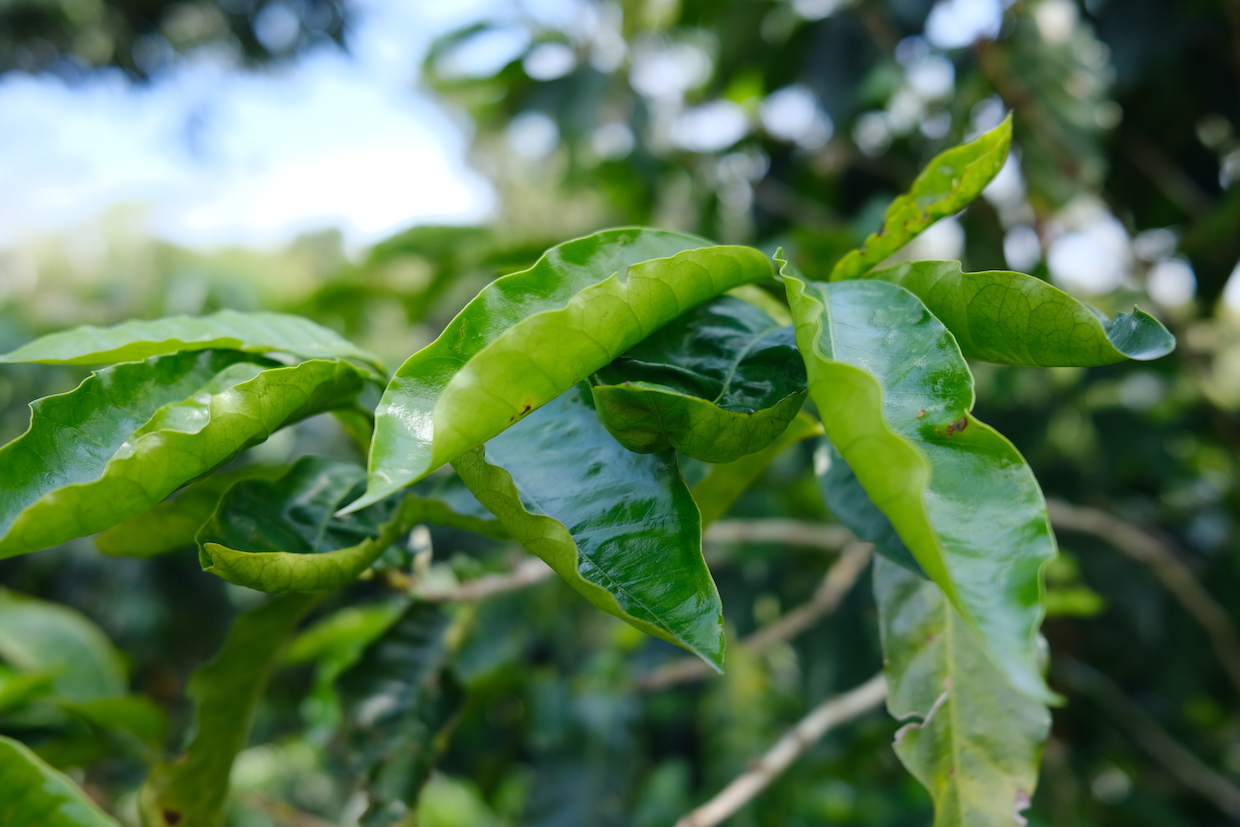
Daily Coffee News photo by Nick Brown.
The coffee industry’s largest coordinated field trial has found that recently bred arabica varieties generally provided higher yields and greater resistance to coffee leaf rust than traditional pure-arabica varieties, while revealing important differences in how varieties performed across climates.
Published Oct. 2 in Scientific Reports, the study represents the latest output from World Coffee Research (WCR) and its long-running International Multilocation Variety Trial (IMLVT). The work was backed by WCR member companies.
The variety trial initiative, launched in 2015, last year resulted in a study examining coffee leaf rust resistance among 29 arabica varieties at 23 sites in 15 countries. The new research expands that work by examining both disease resistance and yield performance under different climatic conditions.
Both studies come against the backdrop of ongoing climate change and its effects on commercial arabica production, while WCR and partner institutions work toward strategic coffee breeding.
“Ensuring the resilience of global food and agricultural systems under climate change is one of the defining challenges of the coming decades,” the study authors wrote. “Climate variability already drives instability in yields and markets, and projected increases in temperature extremes, drought, and erratic rainfall are expected to further disrupt production systems and shift the geography of suitable cultivation areas.”
New Findings
The new analysis involved 32 arabica varieties at 30 research sites across 17 countries, drawing on field data collected between 2015 and 2023.
Led by researchers from the International Center for Tropical Agriculture (CIAT) and WCR, the study examined how coffee varieties respond to differences in temperature, rainfall and humidity, with the goal of informing breeding and planting decisions.
Following data-quality screening, researchers included 20 trial sites in the yield analysis and 24 in the coffee leaf rust analysis.
Top-Performing Varieties
Two F1 hybrid arabica varieties, H1 Centroamericano and EC16, also known as Mundo Maya, emerged as the highest-yielding varieties, followed by Parainema and Ruiru 11. All four also demonstrated relatively strong resistance to coffee leaf rust, a persistent foe to coffee producers all over the world.
Importantly, the performances of those varieties varied based on climate, often significantly.
EC16 performed better in cooler environments with pronounced temperature differences between day and night, while H1 Centroamericano showed better adaptation to warmer climates with relatively stable temperatures. Parainema and Ruiru 11 also tended to perform better in cooler, more temperature-variable conditions.
Other introgressed arabica varieties — including IPR103, Col5 and S4808 — offered a different advantage: relatively strong yields and more consistent performance across different climates.
Many of the better-performing varieties were bred with disease-resistance genetics originating from other coffee species, including robusta. As a group, traditional pure-arabica varieties generally produced lower yields and showed greater susceptibility to leaf rust.
The researchers also found that leaf rust tended to be more severe under warmer, more humid conditions, although disease responses varied among varieties and locations.
“Overall, introgressed varieties consistently outperformed pure arabica varieties, which exhibited lower yields and greater rust susceptibility,” the study states. “These findings provide a robust empirical basis for climate-informed variety deployment and breeding strategies in arabica coffee.”
Collecting Evidence
The research adds to a growing body of information supporting coffee planting or replanting decisions as climate change alters the coffee-growing landscape.
Earlier this year, WCR and CIAT launched the CafeClima platform, which uses IMLVT data and climate projections to help identify varieties suited to current and future growing conditions.
In the new analysis, researchers cautioned against assuming that the highest-yielding varieties would be the best choice for every farm. The study did not evaluate cup quality. WCR has also previously noted that F1 hybrids are more expensive and harder to mass produce than conventional varieties, generally requiring propagation through specialized nurseries.
The authors wrote that “promising varieties should be validated under local environmental and management conditions” before being recommended for widespread planting.
The study was funded by WCR member companies. The authors said those companies had no role in study design, data collection, analysis or reporting. The disclosure does not otherwise identify individual competing interests.
Comments? Questions? News to share? Contact DCN’s editors here. For all the latest coffee industry news, subscribe to the DCN newsletter.
Related Posts
Nick Brown
Nick Brown is the editor of Daily Coffee News by Roast Magazine.


Comment