



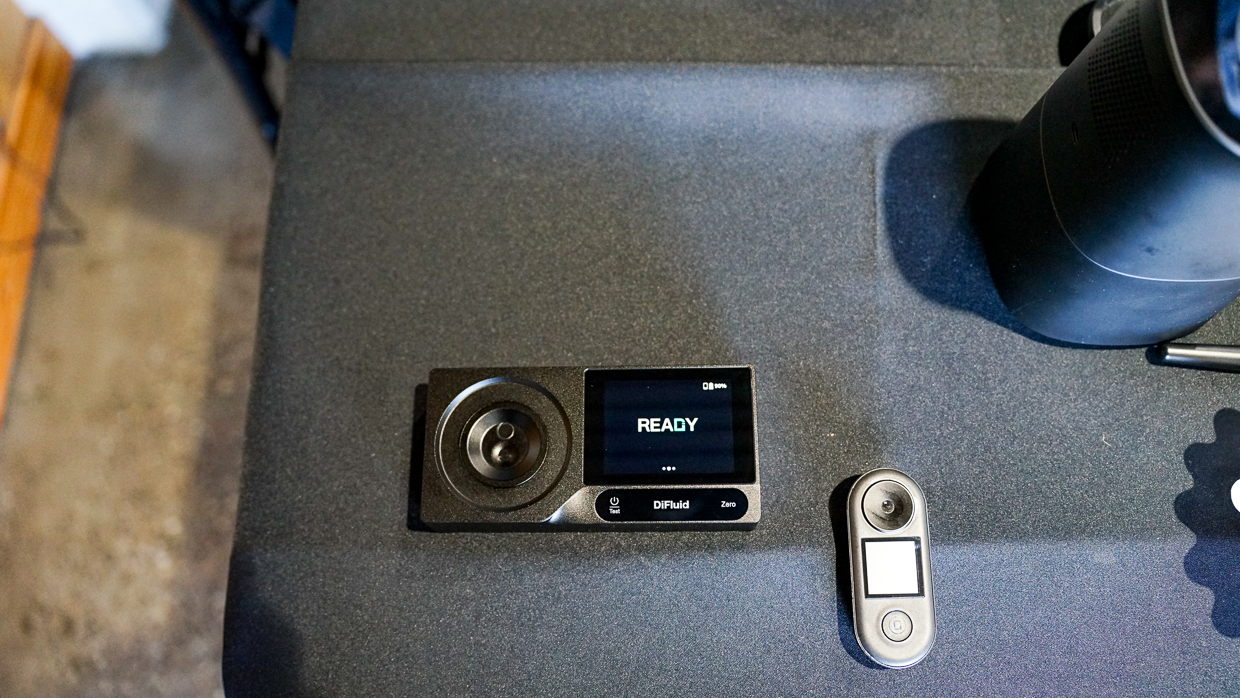
The DiFluid RS Extract coffee refractometer. Daily Coffee News photo by Howard Bryman at the 2026 Roast Summit in Portland, Oregon.
Chinese coffee analysis equipment maker DiFluid has rolled out a new professional refractometer called the RS Extract for measuring total dissolved solids (TDS) in brewed coffee. The device can also connect directly to DiFluid brewing scales to display live brew data on a 3.5-inch color touchscreen.
Shown for the first time in the United States at the 2026 Roast Summit event in Portland, Oregon, in early October, the RS Extract carries a retail price of $639, with discounted preorders underway ahead of shipments scheduled to begin Oct. 25.
Larger and heavier than DiFluid’s existing and more portable Brix and TDS meters, the metal-clad RS Extract is designed to quickly turn out measurements across a much broader range of sample temperatures, while promising improved accuracy and ease of use.

Daily Coffee News photo by Howard Bryman at the 2026 Roast Summit in Portland, Oregon.
“One of the main contributing factors to how TDS is measured is the temperature. As liquid heats up, the molecules expand, and you get this perception of it being lower TDS, so you have to have an algorithm that compensates for the temperature,” DiFluid Program Manager Ben Barnard told Daily Coffee News. “This one does that way better than our previous models, to the point where you can test cold brew or hot coffee just by putting it in the dish.”
DiFluid’s existing R2 Extract refractometer requires samples to fall within a narrower temperature range 20-40°C (68-104°F), which can mean cooling hot coffee or warming cold coffee before testing. The new RS Extract expands that usable range to 4-65°C (39.2-149°F), eliminating the temperature-modification step for most brewed coffee and streamlining the workflow for busy bars.
“Just mix or homogenize the fluid, pour it, fill up the sample tray, hit ‘test’ and that’s the number,” Barnard said.
While intended primarily for use on coffee bars and in labs, the RS Extract remains portable enough for competition and field-service applications. DiFluid is also positioning the device for technicians and other users who need objective brew-strength measurements without relying solely on sensory evaluation.

Daily Coffee News photo by Howard Bryman at the 2026 Roast Summit in Portland, Oregon.
“The super-autos, the espresso machines that you see anywhere from cafes to gas stations or car dealerships, you still want to have high-quality coffee. You want to make sure that the coffee is being served well, but the people who are using it don’t necessarily know much about coffee,” Barnard said. “When you have [TDS] data, it’s now a point that can help you make sure [your equipment] is adjusted accurately, rather than having to train someone for a year on how to taste and notice these nuances.”
DiFluid calls the RS Extract’s new temperature-correction system Cooling Curve Compensation. It uses ambient temperature and the temperature in the sample well to calculate a stabilized reading. Physical changes include a temperature sensor positioned directly at the sample well, while the device’s metal construction and magnetic metal lid help the sample reach equilibrium while limiting light exposure and evaporation.
During brewing, the RS Extract’s touchscreen can display DiFluid’s Brew Control chart and show weight, flow rate and time from a connected DiFluid scale. After the brew, the resulting TDS measurement and brewing data can be combined into a single record and synced with DiFluid’s CoffeeOS app.
Daily Coffee News photo by Howard Bryman at the 2026 Roast Summit in Portland, Oregon.
“This sets it up for a cafe or a lab setting where you don’t want to be on your phone during service,” Barnard said. “The [RS Extract] device has everything on screen.”
The RS Extract enters a relatively sparse market for coffee-specific refractometers that also includes products from Japanese instrument maker Atago and VST Inc. Atago, which established its U.S. office in 2002, currently sells handheld coffee refractometers for measuring TDS and Brix, while VST developed its first coffee-specific refractometer in 2008. DiFluid will also continue selling its smaller R2 Extract, launched in November 2022.
“Since R2 came out, we’ve been collecting feedback and thinking, what is it that people still need, that we’re not providing?” DiFluid Product Manager and CoffeeOS Creator James Corwin told DCN. “We tried to solve all of those issues and then came RS.”
DiFluid, which was founded in Shenzhen, China, by Linus Peng in 2021, now makes tools for analyzing green coffee, roasted whole-bean and ground coffee, coffee during roasting and brewed coffee. Corwin said an improved ground-coffee particle analysis tool is among projects that may follow the RS Extract.
“How can you improve your coffee? By understanding what it is you’re doing, having concrete data to represent everything across the whole coffee spectrum,” Corwin said. “There’s a lot of different areas in which we can do that. A lot of different products in the works at the same time.”
Comments? Questions? News to share? Contact DCN’s editors here. For all the latest coffee industry news, subscribe to the DCN newsletter.
Related Posts
Howard Bryman
Howard Bryman is the associate editor of Daily Coffee News by Roast Magazine. He is based in Portland, Oregon.



Comment