



As grinders self-adjust, roasters sense first cracks and robotic arms refine their latte hearts, technology dating back to the time of Archimedes is also having a moment in the modern espresso zeitgeist.
Several recently launched new devices are centered on worm gears, hand cranks and other threaded piston systems to push water through coffee.
China’s Ikape Coffee is the latest to launch such a device, the Alkaid manual espresso maker. Earlier this year another Chinese company, Muvna, rolled out the Mach hand-cranked espresso machine. From Germany, a startup called Emanuale is shipping its first round of compact, portable crank-activated espresso makers, while in the UK, the second generation of the Coffeejack manual espresso maker shifts to a crank-driven design. Similar approaches are also appearing in electronic and commercial equipment.
Distinct from traditional, directly manual lever machines and semi-automatic pump-driven machines, these cranked and screw-driven systems now form a small but growing third category of espresso equipment. Here we explore the winding new road of crank-oriented espresso products and their makers.
The Ikape Alkaid Espresso Maker
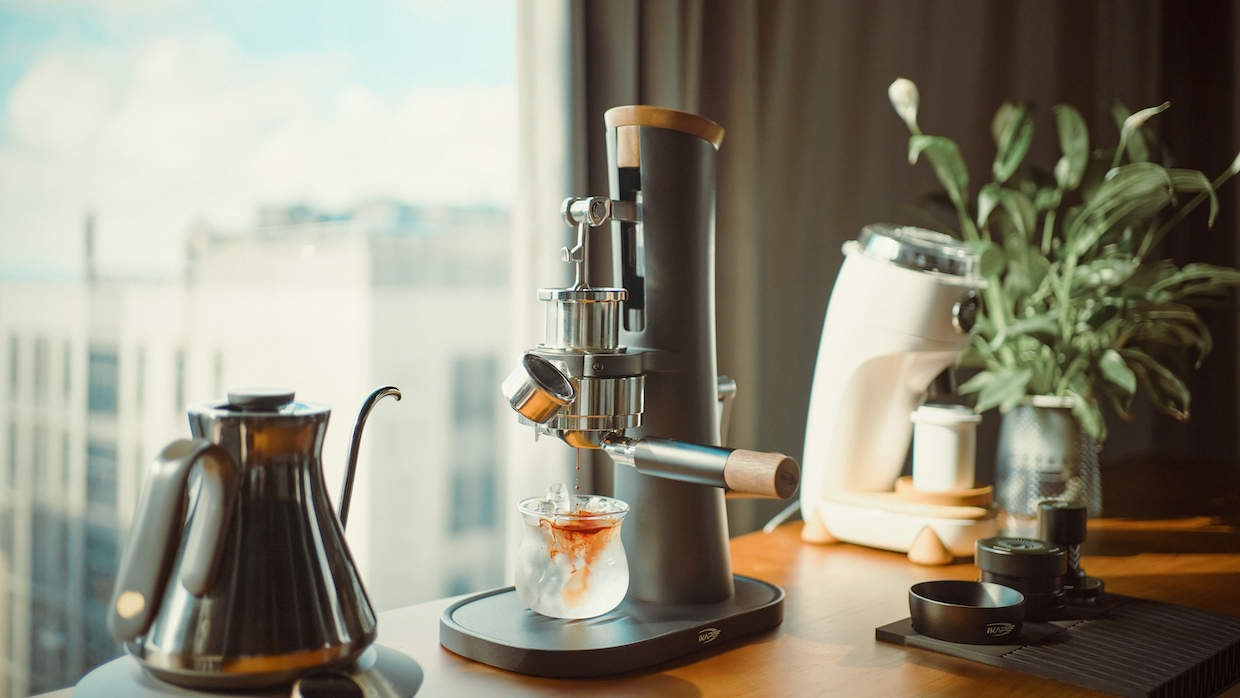
Ikape Alkaid. Courtesy photo.
Shenzhen, China-based Ikape, founded in 2021 by Vincent Tong and Alex Zeng, produces a wide range of manual coffee tools and accessories, including pourover gear, hand grinders and espresso prep tools. The company recently shipped the first round of pre-ordered Alkaid manual espresso machines and has opened direct online sales through its website.
The Alkaid has a 58-millimeter E61-style grouphead with a mounted analogue pressure gauge. Water is pushed into the group by a piston driven by an internal worm-gear mechanism. Turning the wooden-handled crank rotates a gear that drives a threaded rod upward. As the shaft rises, a linkage lowers the piston, pushing water into the coffee. Reversing the crank returns the piston to its starting position.
Users can adjust extraction pressure in real time through their cranking speed and force.
“The Alkaid’s advantage lies in its use of a threaded gear ratio, amplifying relatively small forces through the gears, allowing for easy and stable control of extraction pressure,” an Ikape representative told Daily Coffee News. “Manual espresso machines with lever systems apply pressure directly, without the added benefit of a transmission system. Therefore, the extraction process isn’t as smooth or labor-saving.”
Ikape currently lists the Alkaid at a regular price of $859.99 with a lower promotional price on its website, so the specific price point may vary depending on timing and discounts.
The Muvna Mach

Muvna Mach. Daily Coffee News photo by Howard Bryman.
Muvna is another design-driven Chinese company making a variety of coffee tools and accessories. Founded in 2020 by a team of engineers, product developers and specialty coffee professionals, Muvna announced its crank-driven manual espresso machine late last year.
Sold under the Mach name, the machine features a 58-millimeter E61-style grouphead with a mounted analogue pressure gauge, mostly metal construction, and a wooden handle and base. Turning the crank drives an internal gear train that moves the piston to push water into the coffee. Users can reverse the crank to retract the piston after a shot or continue turning to complete the crankshaft’s reciprocating motion.
The Emanuale
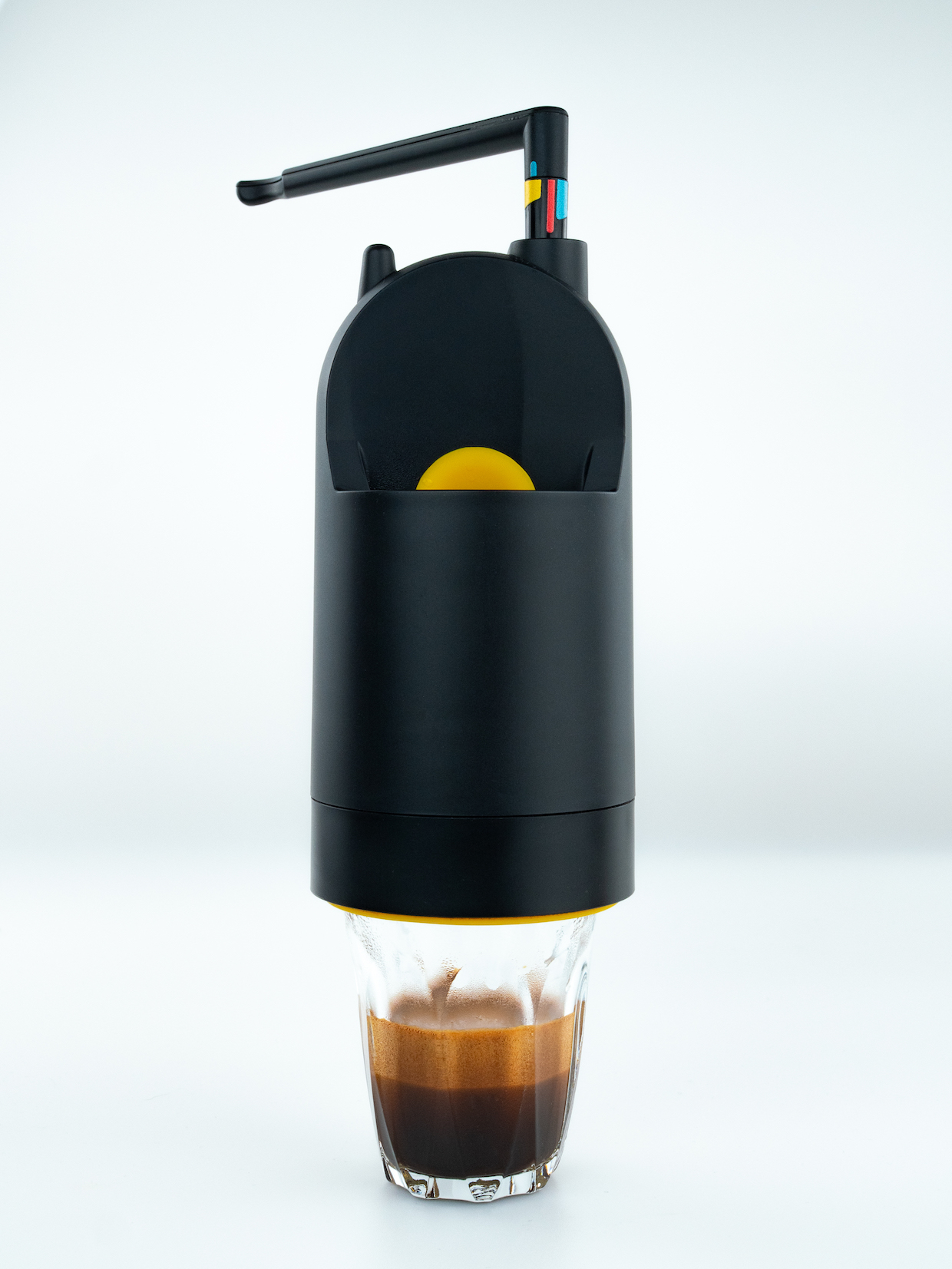
Emanuale. Courtesy photo.
Emanuale is the creation of inventor Jakob Diezinger and Katrin Homberg in Eichstätt, Bavaria, Germany. Founded toward the end of 2023, the company spent roughly three years taking its crank-driven brewer from sketch to finished product, with shipments to early buyers beginning in mid-2025.
The compact device can rest on its own stand or directly atop a cup. A crank on top drives a piston that pushes water down into a coffee-filled 58-millimeter portafilter basket. Ball bearings smooth the motion, and as pressure builds, users can feel it through the handle and adjust in real time.
All parts in contact with water or coffee are made from stainless steel or EU- and FDA-certified food-grade silicones and plastics.
With portability in mind, the Emanuale’s handle stows inside the brewer body, while an integrated dosing ring, subtle markings and color indicators help users dial in consistent ratios and extractions.
“We are passionate surfers and part-time van-lifers. We were looking for a machine with an easy manual espresso workflow that gives us fun and joy but also guarantees high reproducibility, temperature stability and portability,” the founders told Daily Coffee News. “With a manual espresso machine, you get a very good feeling for your prepared coffee cake during the extraction… You can adjust the pressure by turning faster or slower and still hit the perfect extraction time, which results in a slightly over-extracted or under-extracted but still very balanced cup.”
Having now shipped two rounds of pre-orders, the company is currently transitioning to direct sales via its website with the brewer priced at €395 (approximately $459), For a limited time, that price includes a stand and additional accessories that will be sold separately beginning next year.
Coffeejack V2
From the UK, the original Coffeejack system took inspiration from hydraulic car jacks, amplifying minimal manual input into higher forces. The company used crowdfunding in 2019 to drive that design into production, with direct sales following in 2022.
This year it followed up with the Coffeejack V2, featuring a crank connected to a planetary gearbox to convert manual rotation into vertical piston motion.
The company returned to Kickstarter and raised more than $700,000 in support of the V2 in the Spring of this year. The brewer is expected to launch at a retail price around £198 (about $260), according to the campaign materials.
Precursors and Others in the Field
Today’s crank- and screw-driven machines arrive roughly a decade after the founding of Aram, the Brazilian company whose crank-driven espresso maker first launched for sale in 2017 after a successful crowdfunding campaign.

Aram Espresso. Daily Coffee News photo by Nick Brown.
Predating Aram, the earliest new-millennium threaded espresso maker came from Portaspresso in Australia, which launched what is now called The Rossa Hand Espresso in 2009.
“I wanted portable espresso, but there was nothing available that could make espresso as good or better than a quality espresso machine. In order to get a machine that was of the quality I sort, I had no choice but to design and make my own,” Ross Spencer, founder of Portaspresso and inventor of the Rossa, told Daily Coffee News. “My original intention was to create the smallest machine possible that could still produce the highest quality espresso… The screw piston design was deemed the simplest, but it took significant trial and error to create a design that was easy to operate, and there have been a number of improvements over the years.”
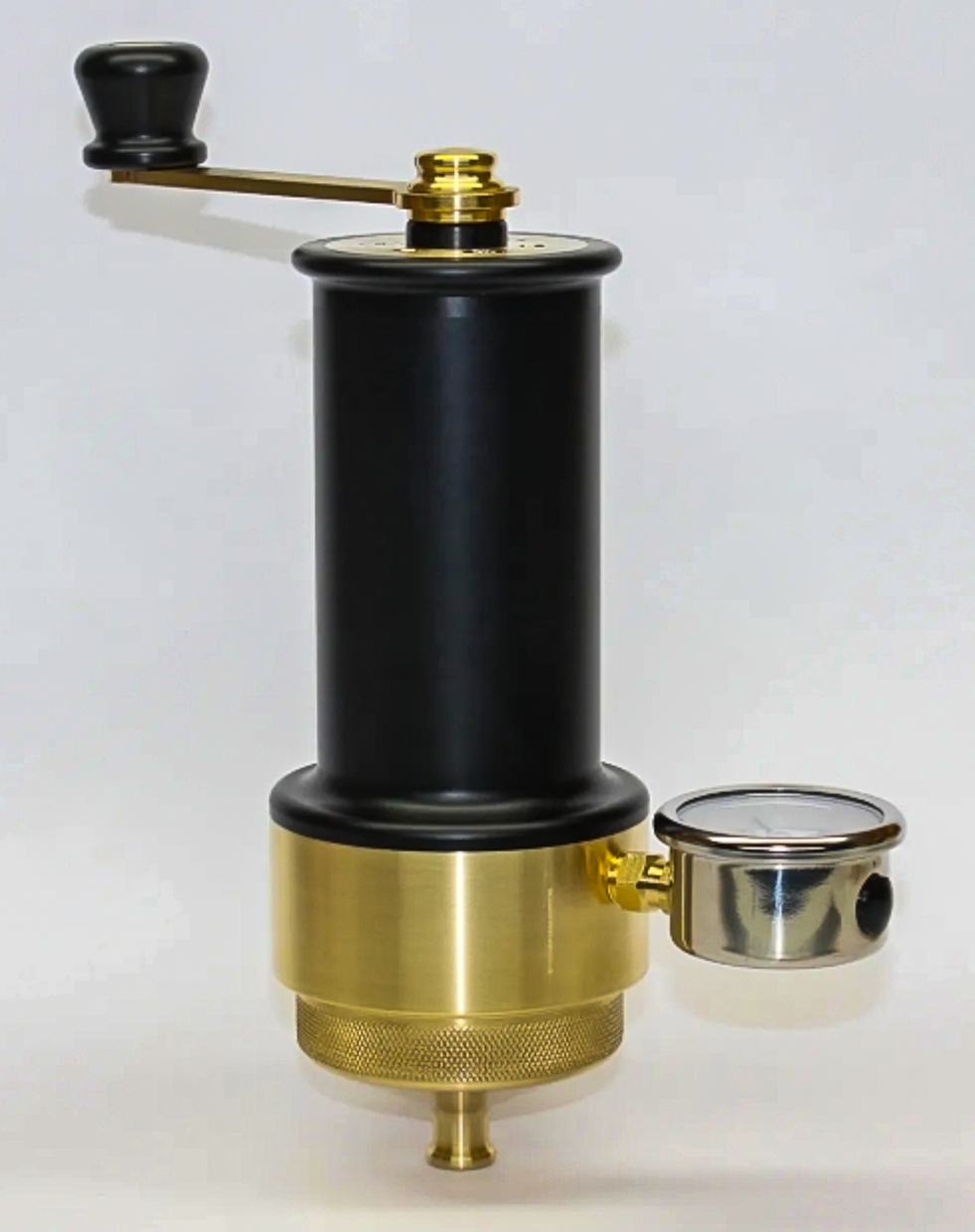
Portaspresso Rossa. Courtesy photo.
Similar mechanical principles have been applied in coffee beyond manual espresso. In late 2023, Weber Workshops introduced the Bird brewer, a no-bypass immersion system that uses a threaded stainless drive shaft and a brass wing nut mechanism for agitation and for pulling the brew chamber upward through the water at the end of the brew, creating a vacuum-pressured separation of grounds and liquid.
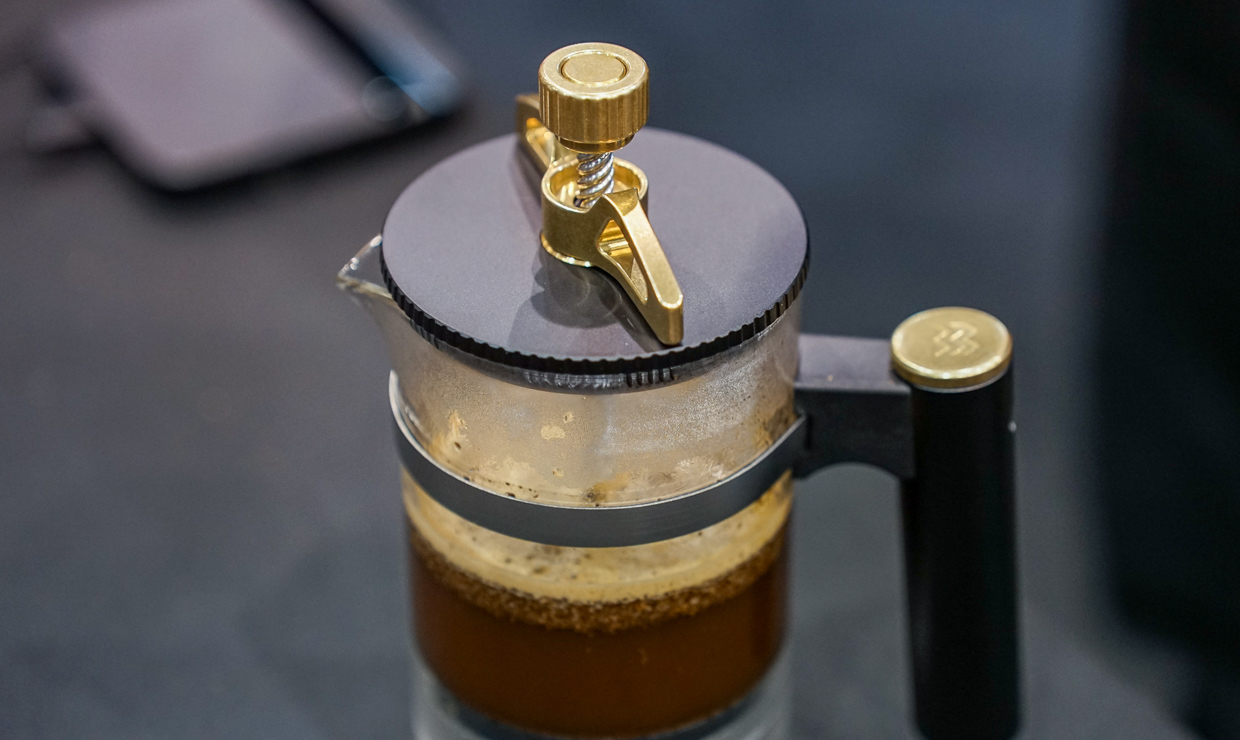
Weber Bird. Daily Coffee News photo by Howard Bryman.
On the commercial front, the Duvall FC-1 professional espresso machine uses servo-motor-driven ball screws to move horizontal pistons through sealed cylinders, pushing water with precisely controlled flow rates to each brew group.
And in the high-tech home segment, the Meticulous Espresso machine uses a motorized vertical piston and app-controlled profiles of force and flow, applying similar motion-control ideas in fully automated form. Users design, store and share pressure and flow curves, which the machine’s motors follow automatically.
Taken together, these recent products show how some of the most fundamental mechanical concepts — screws, cranks and pistons — are being reinterpreted for a new era of home and professional coffee, while giving users more direct control over pressure, feedback and feel.
Comments? Questions? News to share? Contact DCN’s editors here. For all the latest coffee industry news, subscribe to the DCN newsletter.
Related Posts
Howard Bryman
Howard Bryman is the associate editor of Daily Coffee News by Roast Magazine. He is based in Portland, Oregon.


Comment