


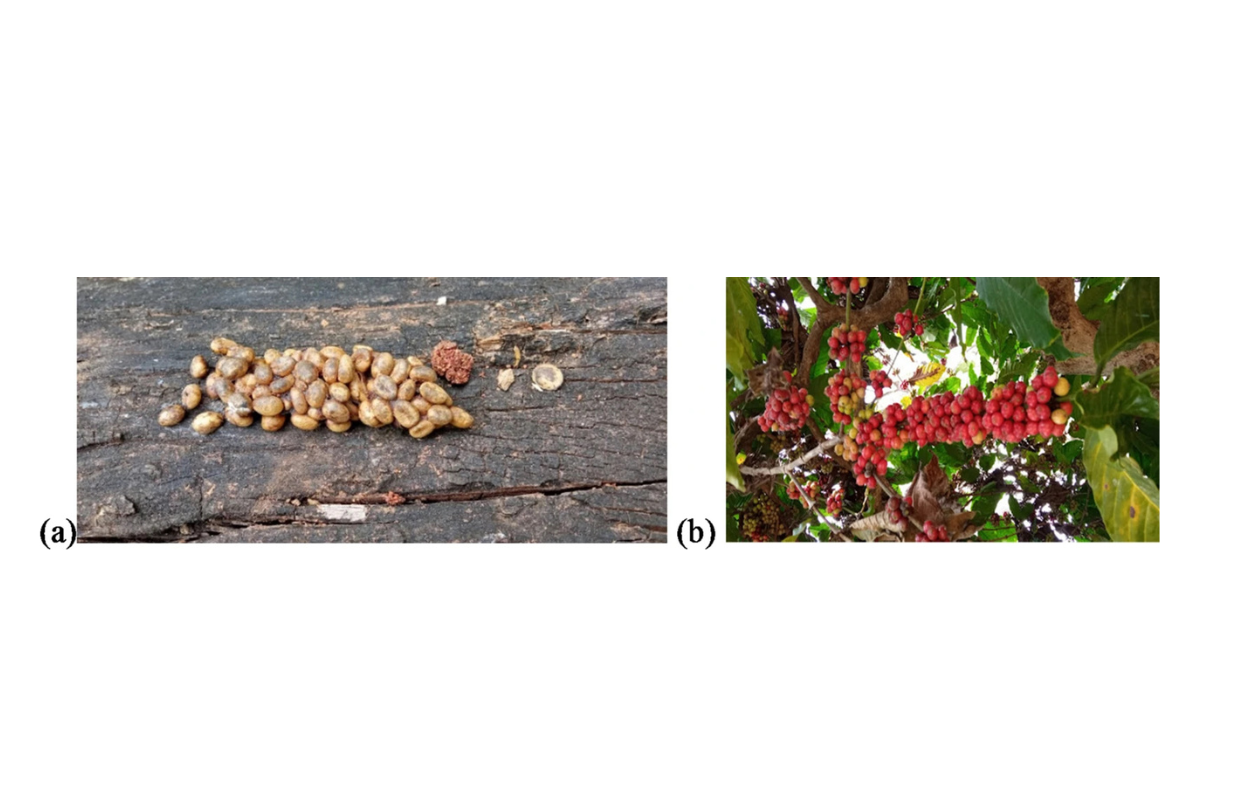
A) Scat of the Asian Common Palm Civet found on a fallen log; and B) ripened berries of robusta coffee from a coffee estate. Photographs by Ramit Mitra. Image shared via Creative Commons Attribution 4.0 International (CC BY 4.0).
Civet coffee (a.k.a. kopi luwak) remains one of the coffee world’s most divisive products, invoking sensitive issues such as value chain dynamics, high-end product differentiation, fraud and animal cruelty.
Outside of issues such as authenticity or the conspicuous consumption of rarefied products, a recent paper in Scientific Reports adds some fresh data toward the question, “is it actually different?”
What They Studied
In the study, researchers analyzed unroasted robusta coffee beans recovered from wild Asian palm civet droppings in Kodagu, India, then compared them with beans from ripe robusta cherries collected on the same estates.
The team reported that civet-processed beans showed higher total fat and higher levels of two fatty-acid methyl esters associated with flavor and aroma in other foods, although the authors also wrote that civet and non-civet beans were “not very distinct” when multiple measurements were considered together.
The study focused on the physical and chemical composition of unroasted coffees, which were ground to a fine powder for gas chromatography-mass spectrometry (GC-MS) analysis. Tests were conducted on coffees from organically managed and conventionally managed farms.
How Are They Different?
Following the analysis, two compounds stood out as significantly higher in the civet-derived beans: caprylic acid methyl ester and capric acid methyl ester. The authors described those as “flavoring and aroma agents” that can impart “a dairy or milk-like aroma and flavor” in food applications.
“These observations go with the hypothesis that the civet’s digestive process, comprising natural fermentation along with the enzymatic uptake, modifies the beans’ chemical composition, intensifying the flavour and adding to the distinctive sensory characteristics of civet coffee,” the authors wrote.
At the same time, the authors repeatedly framed the broader debate surrounding kopi luwak composition and quality as unsettled. “The nutritious and aromatic value of civet coffee is disputed,” they wrote.
From a practical standpoint, the research does little to settle ongoing debates about civet coffee quality or sensory characteristics, primarily because the analysis covered raw green coffee. The study also focused on robusta, while higher-end kopi luwak is typically marketed as arabica.
Even as the paper emphasized that its scat samples came from wild civets in a biodiversity hotspot, the authors acknowledged “ongoing debate regarding the ethical issues of civet maintenance” for coffee production and noted that civet coffee is “often subjected to counterfeiting.”
Just two days prior to the study publication last October, the nonprofit Civet Project Foundation and Wild Welfare announced they had uncovered “rampant fraud and serious animal welfare concerns linked to the online sale of civet coffee.”
The authors of the study were all affiliated with the Central University of Kerala in India and reported no competing interests.
Comments? Questions? News to share? Contact DCN’s editors here. For all the latest coffee industry news, subscribe to the DCN newsletter.
Related Posts



Comment