


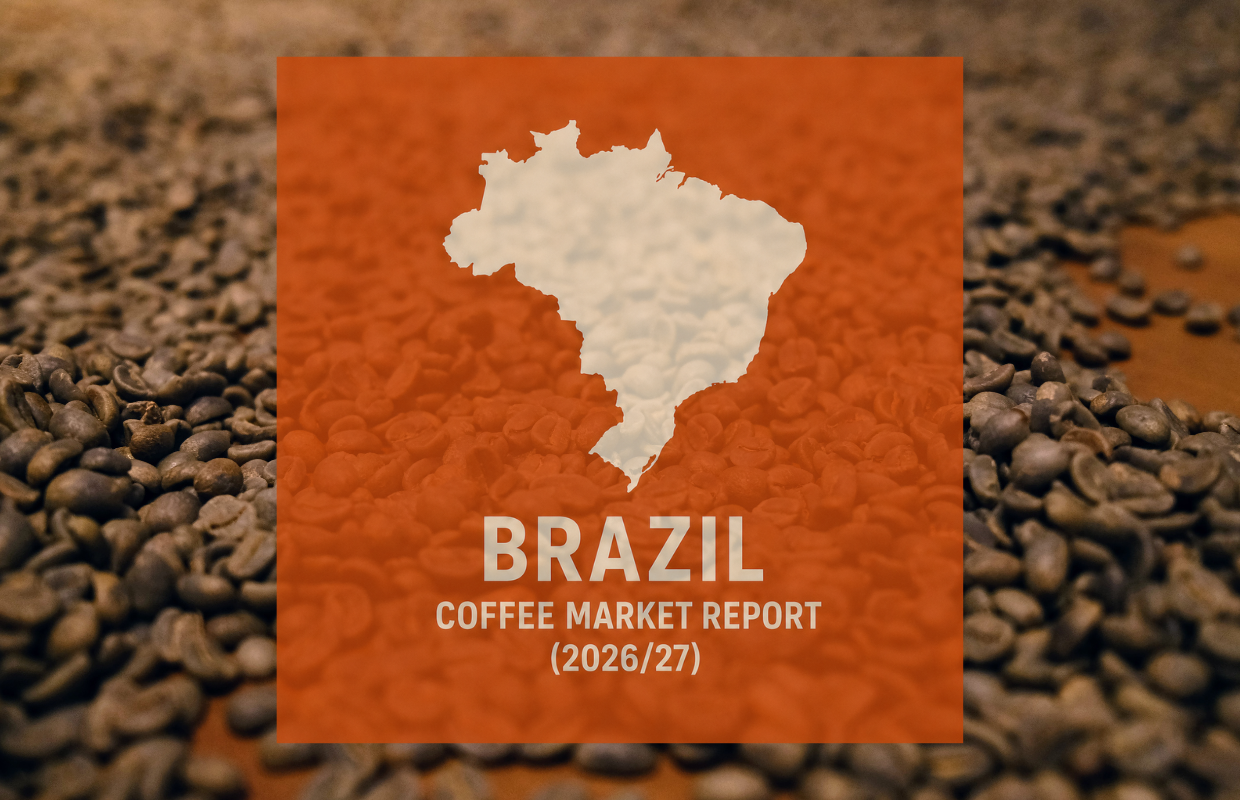
Brazil’s green coffee production is forecast to rise 14.1% to 71.9 million 60-kilogram bags in market year 2026/27, as favorable weather and the high side of the biennial production cycle set up a potential record crop, according to the latest USDA Foreign Agricultural Service annual report.
The report forecasts total exports from the world’s largest coffee-producing country to rise 29.6% to 49.07 million 60-kilogram bags, following a year in which low domestic stocks limited shipments.
Domestic consumption in Brazil, the world’s second-largest coffee-consuming country behind the United States, is forecast to rise slightly to 22.39 million 60-kilogram bags.
The FAS forecast appears to align with a broader market view in recent weeks that Brazil’s larger crop could ease supply tightness and bring down C-market prices, although El Niño risk and low stocks remain.
[Note: This is part of an ongoing series of DCN stories that explore USDA FAS country-level coffee reports, which are produced by different authors and field offices around the world.]
Production Jumps After Five Weak Arabica Years
The 2026/27 forecast would put Brazil’s total production above the 63 million bags estimated for 2025/26 and the 65.5 million bags estimated for 2024/25. FAS said the expected crop could end a five-year stretch of relatively weak arabica production caused largely by adverse weather.
Arabica production is forecast to rise 25% year over year to 47.5 million bags, driven by the positive biennial cycle, larger cultivated area, better crop management and more favorable weather. Robusta production is forecast to dip 2.4% to 24.4 million bags, following a large 2025/26 crop.
Brazilian government agencies also expect a large crop, though their figures are lower than USDA’s. The National Supply Company, known as CONAB, forecasts 66.7 million bags, while the Brazilian Institute of Geography and Statistics, known as IBGE, forecasts 65.1 million bags. Both projections would still represent sharp gains from the previous crop.
Weather Boosts Crop, but El Niño Looms
FAS said rainfall was irregular in late 2025 but sufficient for the main flowering periods in September and October. More regular rainfall in early 2026 supported strong crop development.
Yet the report also points to a possible El Niño in the second half of 2026 as a major uncertainty. While El Niño could reduce frost risk during Brazil’s winter, excessive heat or poorly timed rainfall during flowering and early development could threaten the 2027/28 crop.
Exports Poised to Rebound
Total exports are forecast at 49.07 million bags, including 45 million bags of green coffee, 4 million bags of soluble coffee and 70,000 bags of roasted coffee. The jump follows a slow start to 2026, when Brazil exported 11.5 million bags from January through April, down 24% from the same period a year earlier.
Germany was Brazil’s top coffee buyer in 2025 — a year marked by market disruptions caused in part by the Trump administration’s tariffs on goods from key coffee suppliers — followed by the United States, Italy, Japan and Belgium.
The report said Brazil typically supplies about 32% of U.S. green coffee imports, ahead of Colombia, Vietnam and Honduras.
Prices Fall, Costs Stay High
Brazilian coffee prices began easing as the larger crop came into view. In April 2026, arabica averaged BRL 1,811.87 per 60-kilogram bag, down 28% from April 2025, while robusta fell 46% year over year to BRL 917.05 per 60-kilogram bag.
For producers, lower coffee prices are colliding with high costs. FAS said the coffee-to-fertilizer exchange ratio has worsened, with producers needing 4.97 bags of arabica to buy one ton of fertilizer in April 2026, compared with 2.25 bags a year earlier.
Producers Adapt as Stocks Rebuild
Some farmers are turning to “Zero Crop, 100% Crop,” a pruning strategy that divides farms into resting and producing blocks to manage labor, fertilizer use and plant recovery. Others are diversifying with cover crops, food crops, flowers or direct-to-consumer specialty coffee sales.
Ending stocks are forecast to rise to 4.425 million bags, up from 3.895 million bags in 2025/26, while Brazil’s Coffee Economy Defense Fund, known as FUNCAFE, is budgeted at BRL 7.37 billion (approximately US$1.46 billion) for 2026/27 to support crop management, marketing, coffee acquisition, plantation recovery and working capital.
Comments? Questions? News to share? Contact DCN’s editors here. For all the latest coffee industry news, subscribe to the DCN newsletter.
Related Posts

Comment