


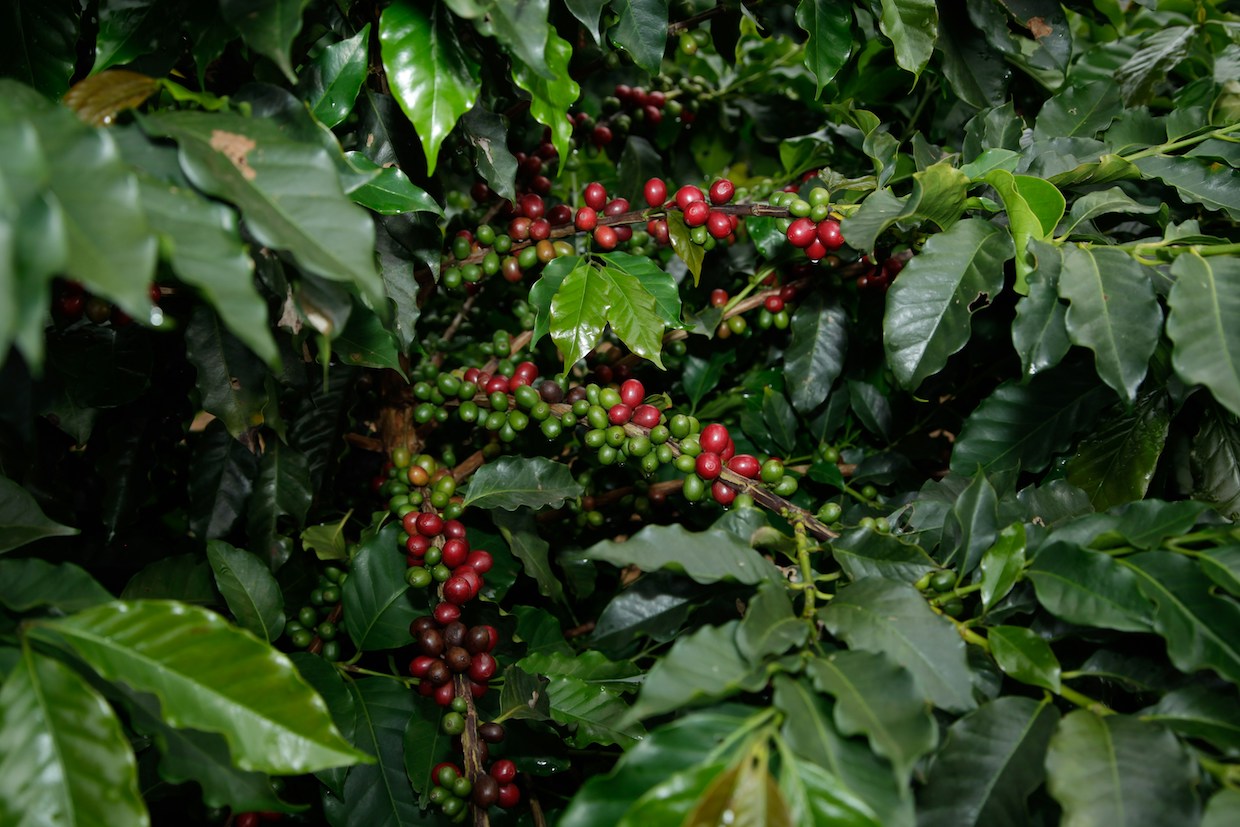
Researchers in China say they have identified a naturally occurring fungus in coffee cherries that, when used as a fermentation agent under controlled conditions, can raise certain conventional coffees into specialty-grade territory.
Coming from the Kunming Institute of Botany at the Chinese Academy of Sciences and published in March in the Elsevier journal Food Chemistry, the study found that controlled fermentation with the fungus added a distinctive vanilla-cinnamon character to conventional arabica coffee samples from Yunnan, China’s main coffee-growing region.
The research adds to a growing body of work on how controlled fermentation during post-harvest processing can alter coffee quality.
While specialty coffee has wholeheartedly embraced controlled fermentation in search of highly differentiated profiles, some researchers, like the Chinese team and recent research groups in Colombia and Brazil, have explored how fermentation practices might give lower-scoring conventional coffees a quality bump in order to, theoretically, command higher prices.
One Fungal Strain Dominates
The research team, led by Minghua Qiu at the Kunming Institute of Botany, spent years building what amounts to a microbial library. They collected coffee cherries from five Yunnan arabica cultivars across three ripeness stages, ultimately isolating 655 endophytic fungal strains. Endophytic fungi are microorganisms that live inside healthy plant tissue.
For the study, six representative strains were screened for their ability to break down pectin found in coffee cherries and produce flavor-relevant enzymes. After all six were used in lab-controlled fermentation and evaluated, one proved to be a clear winner.
The researchers said that a fungal strain called Talaromyces funiculosus KQ2 elevated coffee’s sensory score by 1.5 points on average, while helping develop the pronounced vanilla and cinnamon flavors. The KQ2-fermented coffee also showed 17% higher sucrose content.
Fungal Strains and Terroir
While offering insights into specific fungal applications, the study also leans on the well-worn concept of terroir, supporting the idea that a region’s native microbial community helps shape the way its coffee tastes.
Conventional fermentation strategies typically introduce exogenous (outside) microorganisms after the cherry has been depulped. Those approaches help with pectin breakdown and generate flavor precursors. Endophytic fungi are a different proposition, since they inhabit the cherry tissue throughout its development. The authors describe KQ2 and similar strains as acting as “primary processing plants” inside the cherry itself.
One major caveat is that lab-controlled fermentation with endophytic strains cannot fully replicate real-world fermentation at a farm or mill, where potentially hundreds of kilograms of coffee at different ripeness stages may be processed together. The quality-related gains reported here also may not translate cleanly across other coffee varieties, regions or production settings.
The study was funded by the National Natural Science Foundation of China, the Key Research and Development Project of Yunnan Province and several additional Chinese government and CAS programs. The authors did not declare competing interests.
Comments? Questions? News to share? Contact DCN’s editors here. For all the latest coffee industry news, subscribe to the DCN newsletter.
Related Posts



Comment