


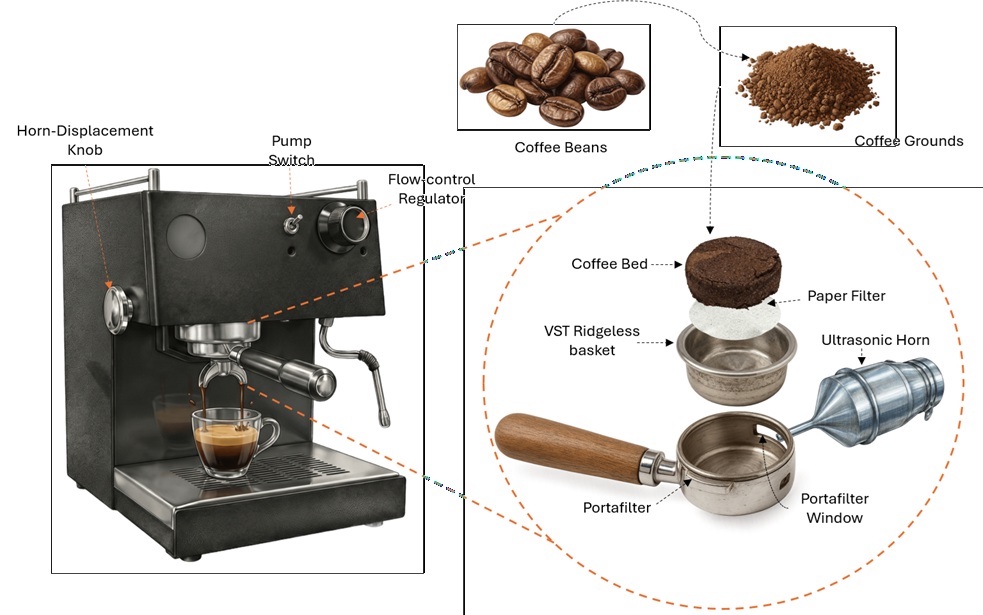
Schematic representation of the ultrasonic espresso machine. UNSW press release image.
Researchers in Australia say they have developed a new way to brew espresso-strength coffee with room-temperature water in 2-3 minutes by turning a portafilter basket into an ultrasonic reactor while using a fraction of the energy required by a conventional espresso machine.
Corresponding author Francisco Trujillo and a research team at UNSW Sydney’s School of Chemical Engineering have referred to the process as “ultrasonic espresso,” while proposing it as a potential process for the coffee industry.
“Traditionally, espresso is by forcing hot water through coffee under pressure. But with ultrasound we can use room-temperature water instead, reducing energy consumption by up to 75%,” Trujillo said in a press release from the university. “It’s a different process, but you get the same richness and concentration of a normal espresso in under three minutes.”
The study, published online June 1 in the Journal of Food Engineering, notes that Trujillo is connected to a pending patent (WO2025/118023A1), assigned to UNSW, for the ultrasonic brewing system evaluated in the study. No other competing interests were declared.
Following Ultrasonic Cold Brew
This is the UNSW team’s second major publication on ultrasonic coffee brewing. DCN covered their first study in May 2024, which showed that cold brew — often steeped for 12-24 hours — could be compressed into under three minutes using an earlier version of the same sonoreactor. That earlier work produced a comparatively dilute, cold-brew-style beverage.
This new study tackles a more complicated brewing formula, matching the concentration and extraction yield of hot espresso without heated brew water.
Measuring Ultrasonic-Brewed Espresso
The system works by coupling high-intensity ultrasound directly into a standard espresso filter basket. The vibrations trigger acoustic “cavitation” — the rapid formation and collapse of microscopic bubbles near coffee particles.
Those collapsing bubbles act like tiny jets, fracturing the grounds and driving flavor compounds, oils and caffeine into the water far faster than heat alone can at low temperature, according to the research team.
The key benchmarks in the study were total dissolved solids (TDS) and extraction yield (EY), the share of soluble solids drawn from the grounds. The paper used the Specialty Coffee Association’s 18-22% EY range as the target zone associated with balanced coffee extraction.
At the finest grind tested — approximately 325 microns — ultrasound-assisted brewing at room temperature reached 18.03% EY, entering that optimal range. Without ultrasound, the same grind under identical conditions reached only 16.26% EY. Across every grind setting tested, no-ultrasound brewing consistently failed to hit optimal extraction values, even with extended brew times.
Sound vs. Heat
The energy comparison was equally stark. Producing three beverages at matched strength — approximately 8.7–8.9% TDS — over a 20-minute window, the ultrasonic system used 0.020 kilowatt-hours versus 0.0823 kWh for a conventional single-group espresso machine. That translates into about 24.3% of the energy, or roughly a 75% reduction.
Those figures exclude startup heating for the conventional machine, which the authors note matters more in domestic use than in continuous commercial operation.
Sensory Results
One hundred untrained coffee consumers evaluated four samples: traditional espresso, ultrasonic espresso, traditional pourover and ultrasonic filter coffee. All samples were served at room temperature, roughly 22°C, to avoid confounding the brewing method comparison with a temperature difference.
The authors noted a limitation of that design, as it does not match typical serving contexts in homes or cafes.
With that caveat in place, the study suggests there were no significant differences in aroma, flavor, bitterness or overall liking between the two espresso preparations.
For filter coffee, 61% of participants preferred the ultrasonic version over conventional pourover, while 7% expressed no preference. The result was statistically significant, driven largely by bitterness and overall sensory appeal.
Chemical analysis found no significant differences in caffeine or chlorogenic acid — an antioxidant naturally present in coffee — between ultrasonic and conventional brews. Volatile compound profiles showed no significant overall differences either, according to the study.
An Ultrasonic Boom?
Ultrasonic or acoustic-cavitation principles are not new to coffee brewing. At least two manufacturers have brought brewing devices with related capabilities to market, including the Osma Pro and the Sonic Dutch Supersonic S1, though links to previously active sales pages to both machines are no longer active.
In the UNSW press release, Trujillo also framed the system as a potential industrial-scale brewing process.
“There are companies that make coffee products on an industrial scale and we are confident this ultrasound system can be scaled up to meet their needs, delivering real benefits in terms of reduced processing times and energy use,” he said. “Because the process produces a concentrated, espresso-strength coffee, it can be used directly to manufacture ready-to-drink products, or shipped as a concentrate and later diluted into a range of drinks, including cold brew and milk-based coffee drinks.”
Comments? Questions? News to share? Contact DCN’s editors here. For all the latest coffee industry news, subscribe to the DCN newsletter.
Related Posts


Comment