


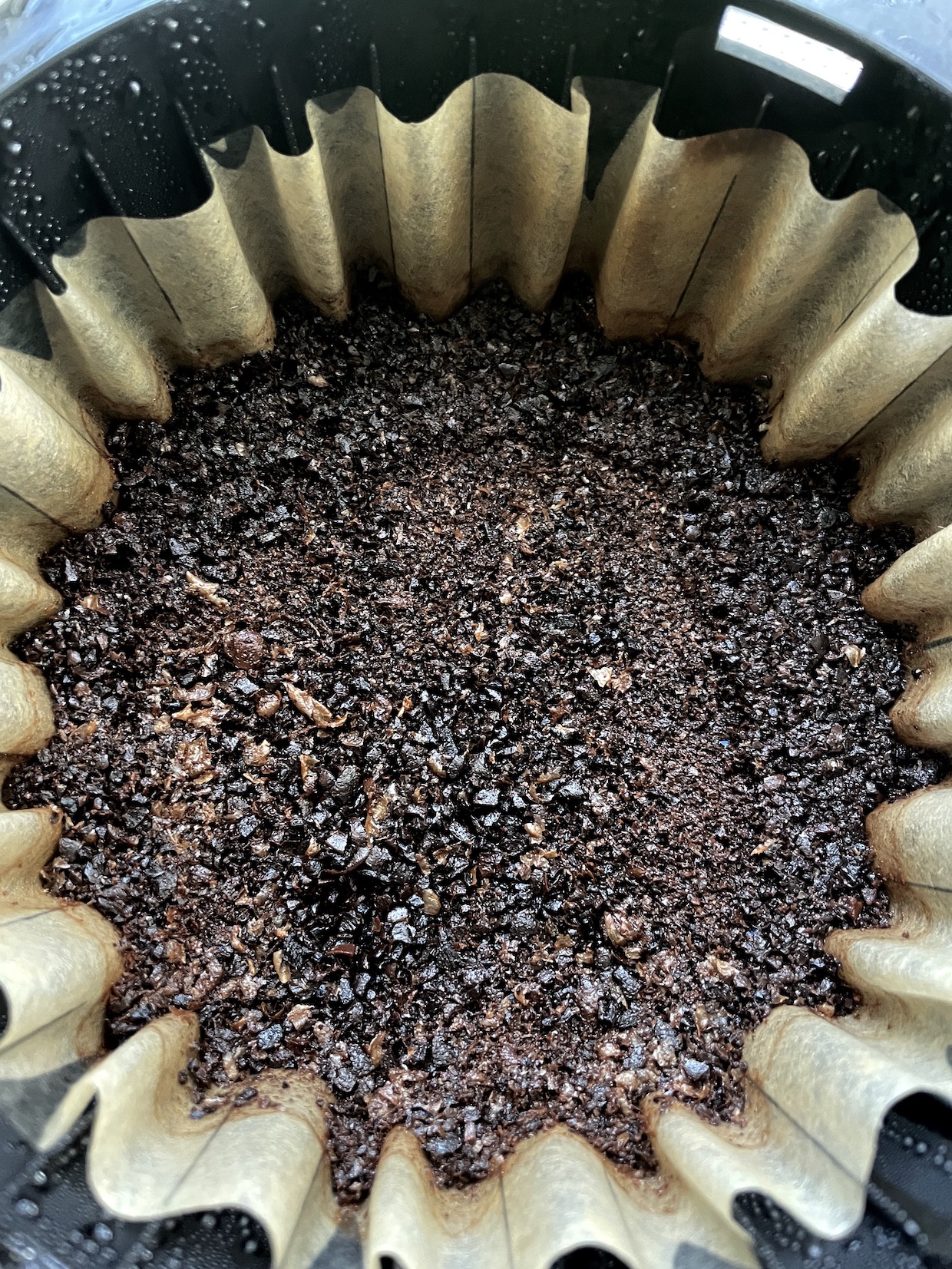
A basket of moist coffee grounds.
Researchers in South Korea say they’ve developed a new process that can convert moist spent coffee grounds into biochar in 90 seconds.
The researchers are promoting the process, tested at a lab scale as opposed to a commercial scale, as a potential pathway to convert a portion of the millions of tons of coffee grounds generated globally each year into a usable fuel source.
“This technology presents a new paradigm in which waste is no longer viewed as a disposal problem but as a valuable energy resource,” Taejun Park, lead author of the study, said in an announcement of the publication in Chemical Engineering Journal. “We plan to expand the technology to various types of high-moisture organic waste and further optimize the process for industrial-scale commercialization.”
Wet Stuff
The researchers note that fresh spent coffee grounds typically have high moisture content, which adds time and costs to conventional conversion processes by requiring extensive pre-drying and other intensive operations. The lab-tested grounds had roughly 55% moisture content.
The technology they employed to create the biochar, called flame plasma pyrolysis (FPP), was developed by researchers at the Korea Institute of Geoscience and Mineral Resources (KIGAM).
According to the researchers, when the plasma flame hits wet coffee grounds, the intense heat vaporizes the internal moisture almost instantly. That creates a rapid buildup of pressure inside each particle, triggering what they call the “popcorn effect” — tiny internal explosions that open pores throughout the material. The moisture, rather than being a barrier to conversion, becomes what the authors describe as “an in-situ steam activation agent,” simultaneously driving carbonization and creating biochar’s highly porous structure.
“The researchers emphasize that the ability to directly process wet feedstocks without pre-drying represents one of the most significant economic and environmental advantages of the technology,” Korea’s National Research Council of Science & Technology said in an announcement.
The scale of the study was notably limited, with 30-gram samples of spent grounds collected from a single cafeteria and tested at a single moisture level.
Biochar in Coffee
Biochar continues to present a range of potential uses within the coffee industry, both in terms of waste diversion and conversion, and as a farm-level input for carbon sequestration and soil health. Yet adoption remains limited across the sector.
On the consumption side, researchers have explored turning spent coffee grounds into biochar for use in strengthening concrete, for water filtration and for industrial carbon filtration.
On the production side, numerous private companies — including Cotierra, Volcafe and Equation Coffee — have invested in biochar-related initiatives in coffee-growing regions, where farm biomass such as coffee stalks can be converted into biochar for a soil amendment that can improve soil health while sequestering carbon.
The former nonprofit Radio Lifeline was a pioneer in promoting biochar as a soil amendment in the coffee sector. More recently, the nonprofit Climate B2C says it has collaborated with researchers at Stanford University and Yale University on coffee biochar field trials and system design, while Stanford has highlighted student research scaling biochar in coffee supply chains.
The new study was funded by multiple South Korean government research programs, with the Ministry of Science and ICT listed as a funder. The authors declared no competing interests.
<p><em>Comments? Questions? News to share? <a href=”https://dailycoffeenews.com/contact/” target=”_blank” rel=”noopener noreferrer”><strong>Contact DCN’s editors here</strong></a>. For all the latest coffee industry news, <a href=”https://dailycoffeenews.com/subscribe/” target=”_blank” rel=”noopener noreferrer”><strong>subscribe to the DCN newsletter</strong></a>.</em></p>
Related Posts



Comment