


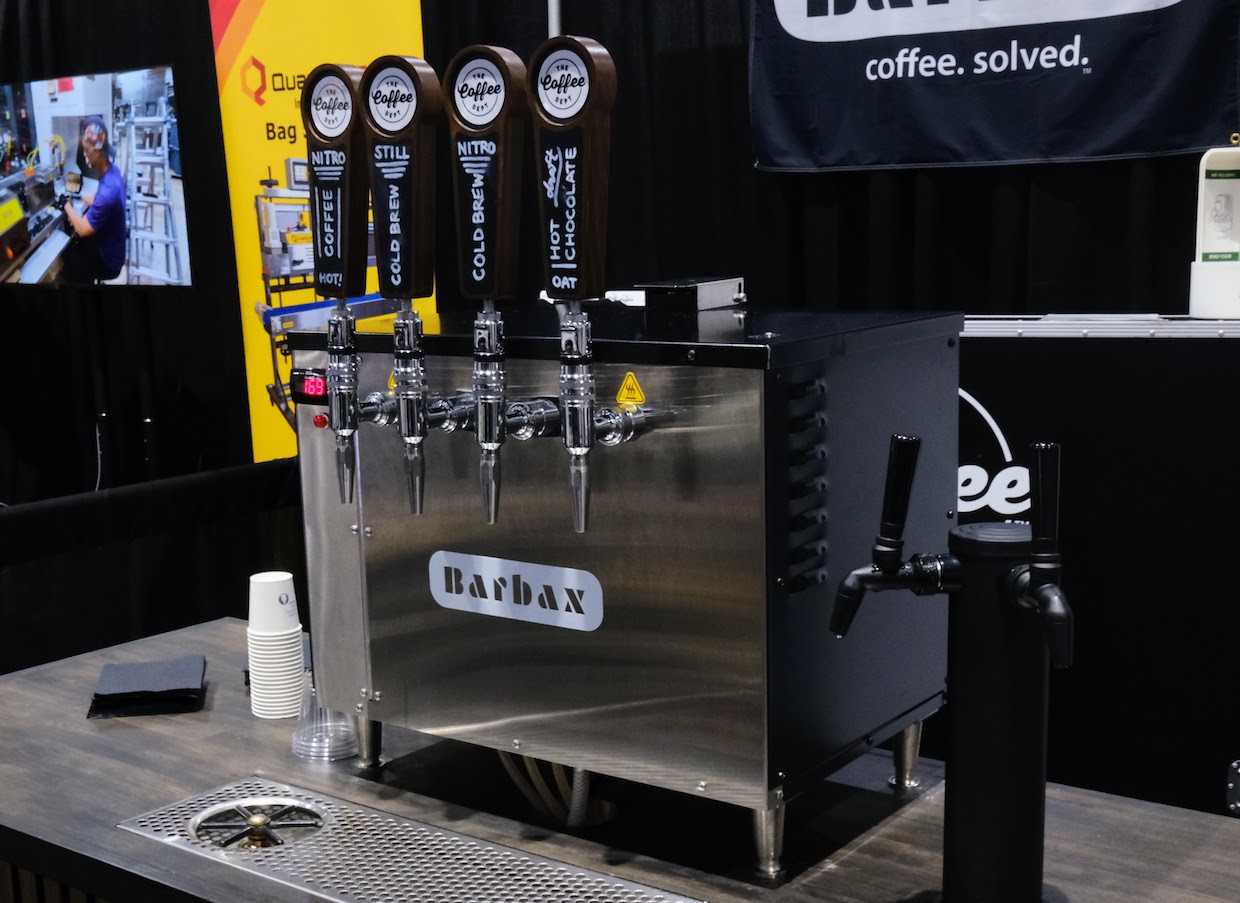
A Barbax multi-tap system on display in San Diego. Daily Coffee News photo by Nick Brown.
Olympia, Washington-based specialty beverage solutions startup The Coffee Dept used the recent World of Coffee San Diego and National Restaurant Association trade shows to introduce Barbax VC, a configurable multi-tap dispensing system capable of serving hot, cold and nitro coffee beverages.
(Read all of DCN’s WOC San Diego coverage.)
Geared toward high-volume locations seeking cafe-quality coffee and other drinks with minimal barista effort, Barbax’s principal pitch is flexibility. The system is designed for hot and cold beverage service while being compatible with bag-in-box, keg and other existing dispensing setups.
The version on display in San Diego included four taps — two hot and two cold for hot nitro brew, hot chocolate, nitro cold brew and still cold brew — though the system can be configured from one to five taps. The hot coffee came from a concentrate measuring approximately 23.5 Brix, diluted through the system at a 13.5-to-1 ratio.
The Barbax VC is designed around a 316 stainless steel, silver-brazed dual-channel plate heat exchanger that circulates a heated liquid to bring products to dispensing temperature on demand.
The Coffee Dept Vice President of Product Design Corey Waldron told DCN that unlike systems that use thermoblocks or copper coil exchangers, the Barbax VC’s exchanger is calibrated to the actual target dispensing temperature, protecting product integrity even after idle periods.

Daily Coffee News photo by Nick Brown.
“You can pour hot coffee through the device, walk away for an hour, come back and pour off an ounce of coffee,” Waldron said. “It’s going to taste exactly like it did an hour ago.”
Waldron, who co-founded and designed the Modbar coffee system in the early 2010s, described a scenario in which a single four-tap Barbax layout — with concentrate, cold brew, hot coffee and milk — could function as a complete beverage station.
Waldron said the machine is NSF-certified for dairy, allowing a pressurized keg of milk below the bar to deliver a microfoam-like pour through a restrictor plate in the faucet.
“You kind of have the makings of a full cafe in a four-tap layout,” Waldron said. “Add your specialty ingredients and your recipe ingredients to combine those into any number of beverages.”
Waldron said the system originated with an inventor and designer who died suddenly, after which the designer’s partners and heirs wanted to keep the project alive. Originally conceived primarily for hot chocolate dispensing in outdoor winter markets, the system has since been rebranded and retooled by The Coffee Dept for a broader, more coffee-specific focus.
“We’re bringing coffee tech into the machine — things like circuitry and other little tricks that come from espresso machine tech to make it perform better and to have more functionality,” Waldron said.
The Coffee Dept itself was founded by a group of partners with deep collective experience in the coffee equipment industry, including president and CEO Laura Sommers, who founded Espresso Supply in 1993, vice president of marketing Kelly Traw and vice president of sales Mike Newgent. Traw and Newgent were key early figures in Espresso Specialists, the Seattle-based distribution company that helped bring La Marzocco machines into the U.S. specialty coffee mainstream through accounts with Starbucks and others.
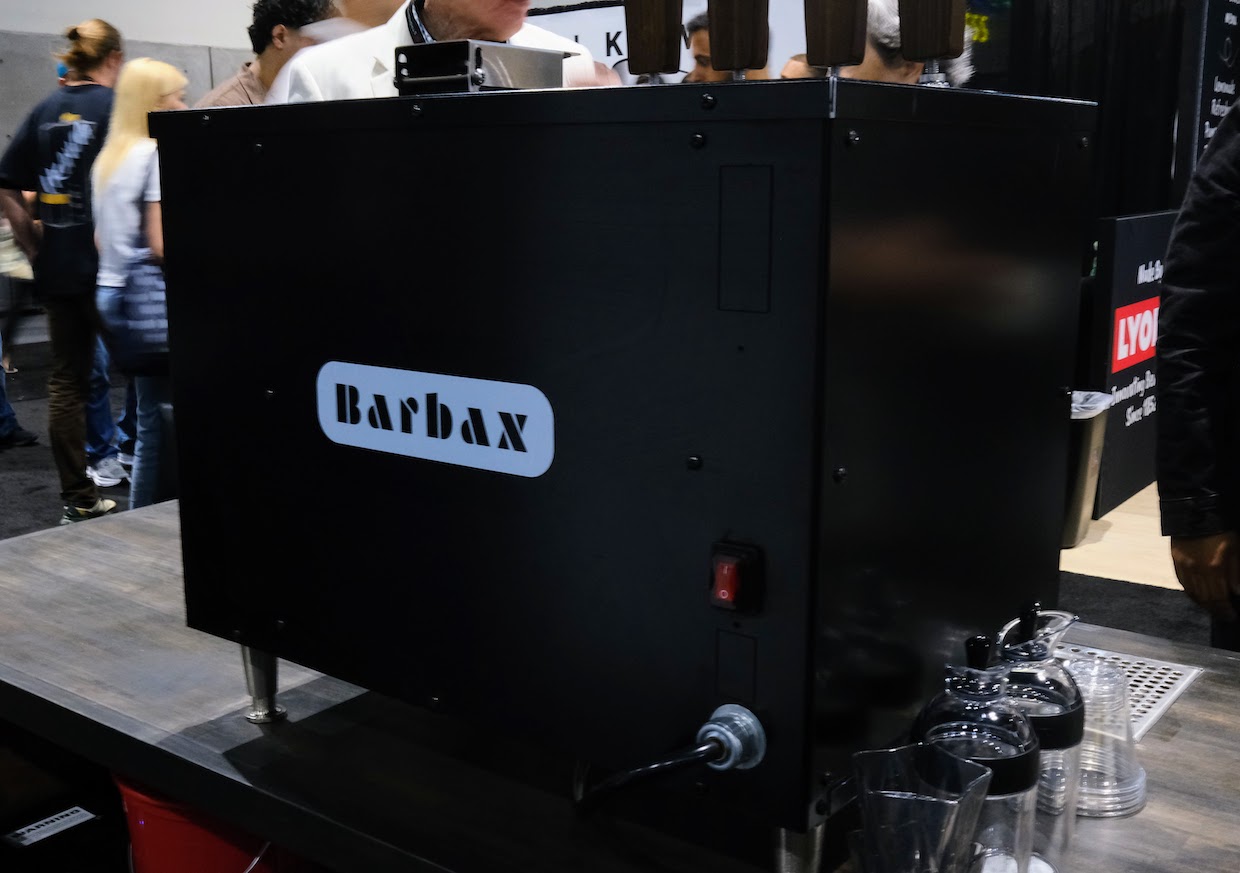
Daily Coffee News photo by Nick Brown.
Company leaders told DCN that The Coffee Dept is focused on craft-oriented coffee equipment systems for restaurants, hotels, bars or other high-volume settings that minimize requirements for highly skilled labor and maintenance. Beyond the Barbax, The Coffee Dept is promoting a standalone reusable cup sanitizing solution called RediUV.
The Barbax joins a small field of specialized coffee dispensing equipment. Beverage equipment brands such as NitroBrew and Kegco have introduced hot-coffee-specific solutions in recent years, while brands including HardTank and Brood have tackled countertop cold brew. Meanwhile, established players such as Marco continue to appeal to different beverage types.
Waldron said the four-tap, 110-volt Barbax version on display was priced around $6,500, with pricing varying based on power and tap configuration. A 220-volt 20-amp version and a more powerful 30-amp version are also available.
“Especially with the 30-amp systems and 20-amp systems, you can’t outpour the machine,” Waldron said. “In theory, you can pretty much open the tap and leave it open, and it’s going to keep up with the demand.”
Comments? Questions? News to share? Contact DCN’s editors here. For all the latest coffee industry news, subscribe to the DCN newsletter.
Related Posts
Nick Brown
Nick Brown is the editor of Daily Coffee News by Roast Magazine.


Comment