


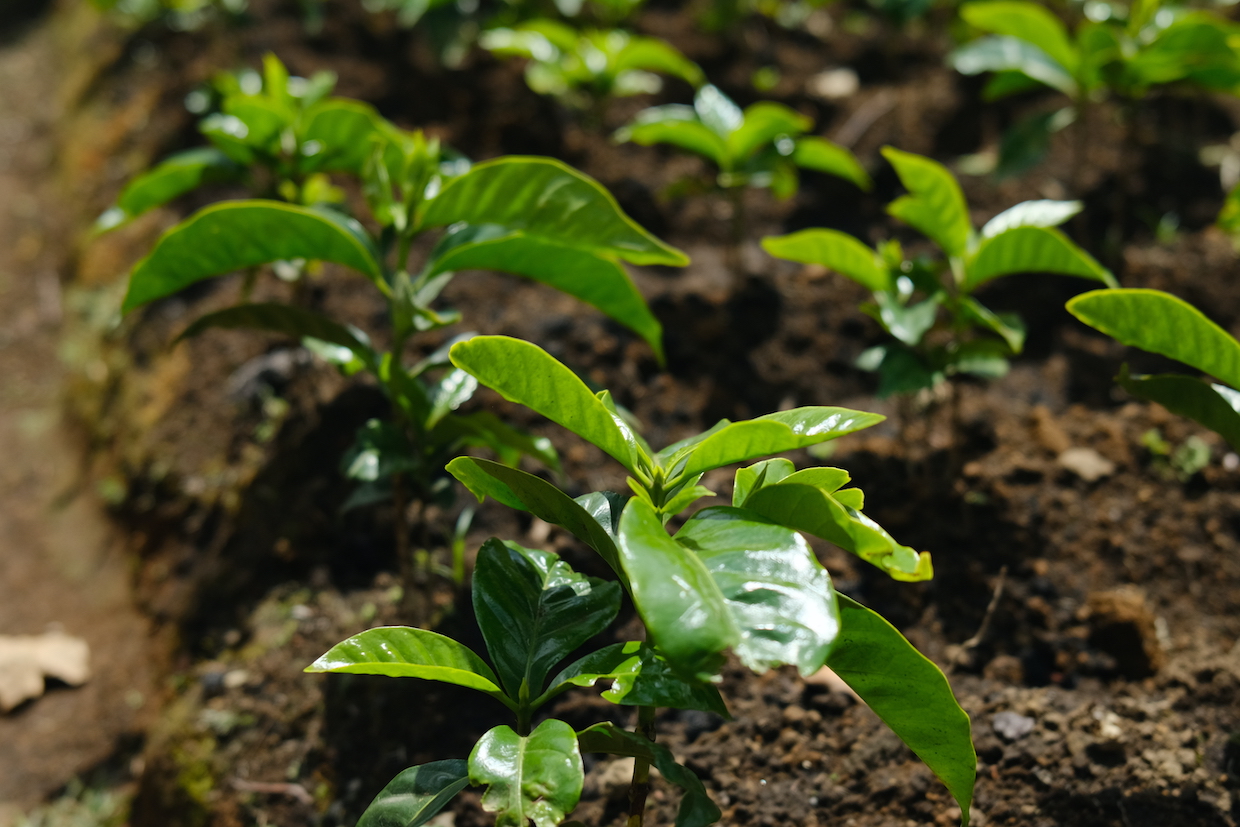
Coffee seedlings in soil. Daily Coffee News photo by Nick Brown.
A new study of seven Brazilian coffee farms suggests that beyond significant environmental benefits, regenerative agriculture can be economically competitive while maintaining strong productivity.
Led by the Brazil arm of the Global Coffee Platform, the study examined the economic, agronomic and environmental performance of seven arabica farms already engaged in regenerative agriculture in Minas Gerais, Brazil.
Although results from the small, non-representative sample can’t be generalized to the broader Brazilian coffee sector or coffee production in other countries, the case study found that operating costs among the farms came in below a state benchmark, while average productivity exceeded a national benchmark.
The seven farms are located in South of Minas and Cerrado Mineiro, comprising four predominantly mechanized farms and three relying primarily on manual labor. All farms were employing one or more regenerative farming practices, such as the use of organic soil inputs, use of non-synthetic fertilizers and maintenance of soil cover, such as cover crops.
“What we found across all seven farms is that different combinations of regenerative practices can deliver competitive production systems, provided they are adapted to the conditions of each farm, implemented consistently and supported by technical guidance,” GCP Brazil Program Director Pedro Ronca said in an announcement of the study.
Costs and Productivity
Effective operating costs on the seven farms ranged from R$488.41 (US$94.87) to R$745.61 ($144.83) per 60-kilogram bag, all below the March 2025 Minas Gerais benchmark of R$768.80 published by Brazil’s National Supply Company (CONAB).
Average productivity among the regenerative plots was 45 60-kilogram bags per hectare, compared with CONAB’s 2025 national average of 30.4 bags per hectare across arabica and robusta coffee. The study said it does not establish that regenerative practices caused the higher yields or lower costs.
Digging Deeper
Among the study’s clearest agronomic findings was the importance of looking deeper than the topsoil.
Soils generally showed favorable conditions in the upper 20 centimeters, while testing between 20 and 80 centimeters revealed problems involving calcium and magnesium balance, aluminum saturation and other conditions that might restrict root growth and limit access to water and nutrients. Similar limitations appeared in both regenerative and reference plots.
The authors identified improving soil fertility at depth as one of the strongest opportunities for increasing drought resilience, production stability and productivity.
Carbon Removal Exceeding Emissions
For the coffee production systems modeled at all seven farms, estimated carbon removals exceeded modeled emissions, according to analyses conducted by Solidaridad using the Cool Farm Tool.
Synthetic nitrogen fertilizers accounted for 46% of modeled greenhouse-gas emissions, while management of agricultural residues such as coffee husks, leaves and pruning material accounted for another 37%.
More Work to Come
The new study was supported by JDE Peet’s, with additional participation from Solidaridad, Cooxupé, Emater-MG and other individual technical experts. The work represents the beginning of a reference-farm and monitoring system that GCP Brazil says may be expanded into other regions and production models, according to the authors.
The findings also add real-farm observations to a growing body of largely modeled research around regenerative coffee. Last year, the nonprofit TechnoServe offered an economic case for regenerative-agriculture investments, while emphasizing that costs and benefits vary substantially according to farm size, country and starting conditions.
“Generating this kind of evidence collectively and pre-competitively is what will allow the whole sector to invest with confidence,” GCP Executive Director Annette Pensel said in an announcement of the new Brazil study. “Data from real farms in real conditions is what turns intent into targeted investment to support producers through the transition.”
Comments? Questions? News to share? Contact DCN’s editors here. For all the latest coffee industry news, subscribe to the DCN newsletter.
Related Posts



Comment